
Last checked September 2026 against 9 sources · Editorial policy
Perimenopause and menopause test: check your stage in 2 minutes
There's no single menopause test that confirms perimenopause: home urine kits and blood tests measure FSH, which swings from day to day in the transition. From 45, NICE guidance identifies perimenopause from symptoms and cycle changes, without lab tests. This free check stages your cycle by STRAW+10 and scores 16 symptoms in about 2 minutes.
- Free · about 2 minutes
- 8 cycle questions (STRAW+10) + 16 symptoms
- Your stage, with the reason for it
Menopause test facts by the numbers
- US Food and Drug Administration ↗
9 in 10
raised FSH levels are detected by home urine tests, per the FDA. Detecting FSH doesn't confirm menopause.
- Harlow et al. 2012 ↗
7+ days
persistent difference in length between consecutive cycles marks the early menopause transition.
- Harlow et al. 2012 ↗
60+ days
without a period marks the late menopause transition, which lasts 1 to 3 years on average.
- NICE, 2024 ↗
12 months
without a period identifies menopause, if you're not using hormonal contraception.
Many medicines and loss of body fat can stop periods, which makes staging from your cycle harder.
Menopause test kits and other tests compared
| Test | Good for | Watch for |
|---|---|---|
Home urine FSH test | Results in minutes at home, no appointment. Detects raised FSH about 9 out of 10 times, per the FDA. | Shows only whether FSH is raised on the day you test, not how high. A negative result doesn't rule out perimenopause, and it can't tell whether you can still get pregnant. |
Mail-in finger-prick hormone test | A lab measures the actual level of FSH, and often other hormones, instead of showing a color change. | Still one sample on one day. FSH swings in perimenopause, so one normal result doesn't rule it out. Results take days, not minutes. |
Blood test from your doctor | Helps confirm menopause between 40 and 45, and is needed to diagnose premature ovarian insufficiency under 40, on 2 samples 4 to 6 weeks apart. Your doctor can add thyroid and iron tests to rule out lookalikes. | From 45, NICE doesn't use lab tests to identify perimenopause or menopause, and advises against estradiol and AMH tests for it. |
Stage check by cycle and symptoms (this page)Start the free check → | Uses what guidelines rely on from 45: your cycle pattern, staged by STRAW+10, and your symptoms. Free, about 2 minutes, and you can retake it in 90 days to see what changed. | Not a diagnosis. It can't stage your cycle if you use hormonal contraception, a hormonal IUD or HRT, or have had a hysterectomy; then your symptom profile is the useful part. |
Home urine FSH test
Good for
Results in minutes at home, no appointment. Detects raised FSH about 9 out of 10 times, per the FDA.Watch for
Shows only whether FSH is raised on the day you test, not how high. A negative result doesn't rule out perimenopause, and it can't tell whether you can still get pregnant.Mail-in finger-prick hormone test
Good for
A lab measures the actual level of FSH, and often other hormones, instead of showing a color change.Watch for
Still one sample on one day. FSH swings in perimenopause, so one normal result doesn't rule it out. Results take days, not minutes.Blood test from your doctor
Good for
Helps confirm menopause between 40 and 45, and is needed to diagnose premature ovarian insufficiency under 40, on 2 samples 4 to 6 weeks apart. Your doctor can add thyroid and iron tests to rule out lookalikes.Watch for
From 45, NICE doesn't use lab tests to identify perimenopause or menopause, and advises against estradiol and AMH tests for it.Stage check by cycle and symptoms (this page)
Good for
Uses what guidelines rely on from 45: your cycle pattern, staged by STRAW+10, and your symptoms. Free, about 2 minutes, and you can retake it in 90 days to see what changed.Watch for
Start the free check →
Not a diagnosis. It can't stage your cycle if you use hormonal contraception, a hormonal IUD or HRT, or have had a hysterectomy; then your symptom profile is the useful part.
Home menopause test: expectation vs reality
What people often expect
“A menopause test will tell me for sure whether I'm in perimenopause”
What the evidence shows
A home menopause test only shows whether FSH in your urine is raised on the day you test. The FDA says these kits detect FSH about 9 out of 10 times but can't tell you for certain that you're in menopause, and a negative result doesn't rule out perimenopause. In the late transition, FSH is sometimes in the menopausal range and sometimes back in the normal range.
How this free menopause test works
- 1
8 questions on your cycle
How regular your periods are, whether one cycle has been a week or more longer or shorter than the one before, and the longest gap in the last 12 months. This places you on STRAW+10: late reproductive, early transition, late transition or postmenopause.
- 2
16 symptoms, scored 0 to 4
How much each has affected you over the past 4 weeks, across heat, sleep, mood, focus and body. The total runs from 0 to 64.
- 3
Your result, free
Your stage with the reason for it, your symptom score, the area that leads, and what else is worth ruling out. Retake it in 90 days to see what changed.
- 4
Optional: a report for your doctor
One page for your appointment, built from your answers and daily log. The doctor-ready report and daily tracking come with a 7-day trial for $1, then $99 a year. Cancel anytime.
| 0–8 | Minimal | Few symptoms right now. |
|---|---|---|
| 9–18 | Mild | Noticeable, but not running your days. |
| 19–30 | Moderate | Affecting more than one part of your day. |
| 31–44 | Marked | Affecting several areas at once. |
| 45–64 | Severe | Heavy symptom load. |
Example result: age 46 · cycle length changed by 7+ days more than once · score 27, moderate · sleep leads.
Start the free check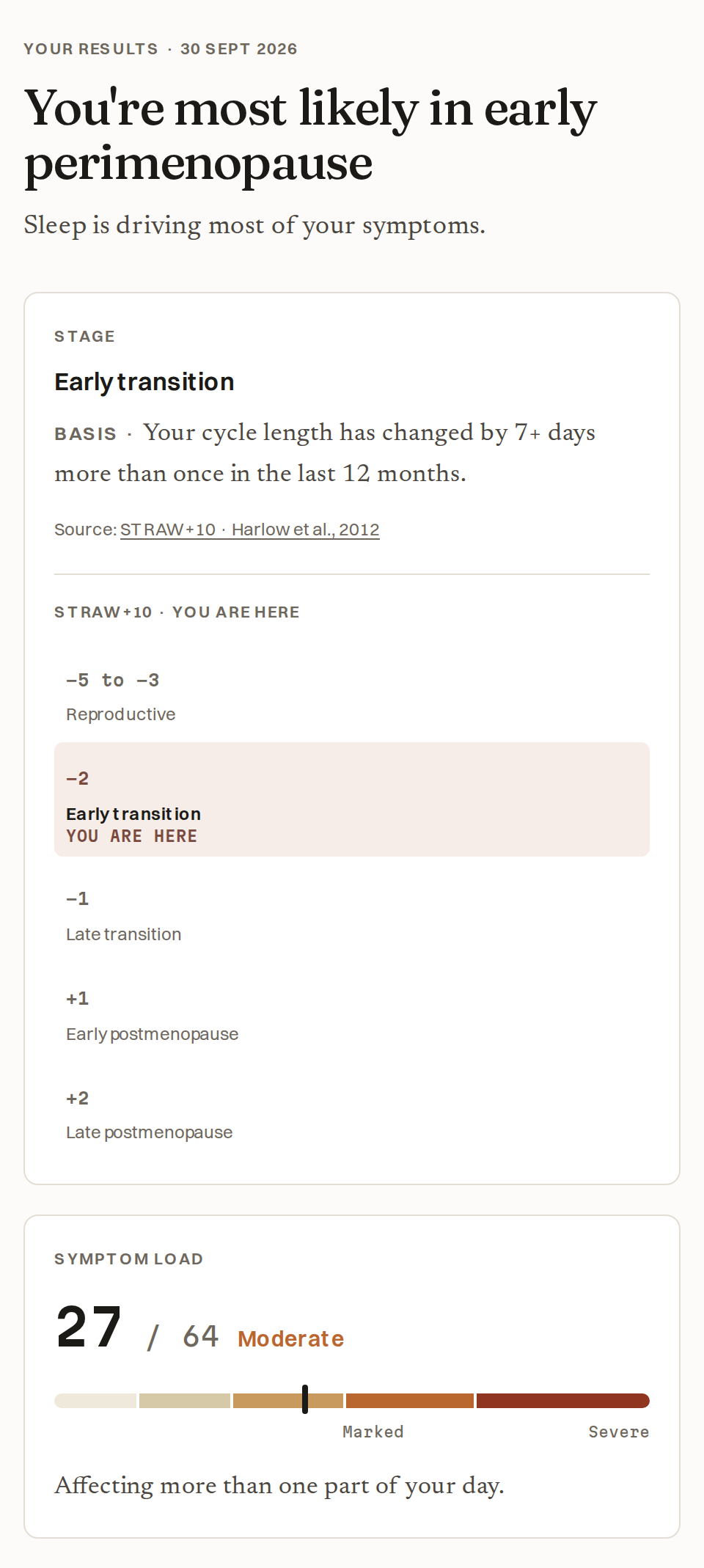
What a menopause test can and can't measure
What a home menopause test measures
Home menopause tests measure follicle-stimulating hormone (FSH) in urine. FSH is made by the pituitary gland, and it rises as the ovaries slow down, because the brain pushes harder to get them working. The tests are qualitative: a color change shows whether FSH is raised, not how high it is. The FDA says they detect FSH about 9 out of 10 times, and that results depend on using first morning urine, how much you've had to drink and medicines you take.
Why one FSH test result can mislead
In perimenopause, FSH doesn't climb in a straight line. In the late transition, STRAW+10 describes FSH as sometimes in the menopausal range and sometimes back in the range of earlier reproductive years, particularly when estradiol is high that day. So a raised result can come during a spike, and a normal one during a dip. That's why a negative home test doesn't rule out perimenopause, and a positive one doesn't mean you've reached menopause.
Blood tests your doctor can order
A blood FSH test gives a number rather than a color. NICE says to consider it to confirm menopause only between 40 and 45 with symptoms and cycle changes, or under 40 when menopause is suspected. Under 40, premature ovarian insufficiency is diagnosed from symptoms plus raised FSH on 2 blood samples taken 4 to 6 weeks apart, never from a single test. From 45, NICE advises against using estradiol, AMH, inhibin or ovarian scans to identify perimenopause or menopause.
When an FSH test doesn't work at all
NICE says not to use an FSH blood test to identify menopause in women using combined estrogen and progestogen contraception or high-dose progestogen. Home kits share the limit, and the FDA and MedlinePlus say they can't tell whether your ovaries are still releasing eggs, so they shouldn't guide decisions about birth control. Many medicines and loss of body fat can also stop periods, which makes the transition harder to stage from your cycle.
What guidelines use instead of a test
From 45, NICE tells doctors to identify perimenopause without lab tests: from hot flashes or night sweats that have recently started, plus any change in your menstrual cycle. Menopause is identified after 12 months without a period in women not using hormonal contraception, and after a hysterectomy from the type of symptoms. This check follows the same logic: your cycle pattern for the stage, and your symptoms for how much the transition is affecting you.
How the stages are defined
STRAW+10 splits the years around the final period into stages. The early transition starts when the length of consecutive cycles differs by 7 days or more and it happens again within 10 cycles. The late transition starts with a gap of 60 days or more without a period and lasts 1 to 3 years on average. Menopause is the final period, confirmed after 12 months without one; the first stage after it lasts about 2 years.
How to use a home menopause test
- Use first morning urine and don't drink a lot beforehand: the FDA says the result depends on both.
- Test on more than one day. FSH swings in perimenopause, so a single result says little either way.
- Don't test while using combined hormonal contraception or high-dose progestogen: the result won't reflect your own hormones.
- Never use a negative result to stop birth control. Home FSH tests can't tell whether you can still get pregnant.
- Take the result to your doctor together with your symptoms and cycle history: that's what the decision rests on.
What a menopause test won't rule out
Irregular periods and tiredness in your 40s aren't always perimenopause. These are the common lookalikes and the test that tells each one apart.
| Could be | Clues | Test |
|---|---|---|
| Pregnancy | A missed or late period, sore breasts, nausea. | Pregnancy test |
| Thyroid problems | Irregular periods with tiredness, weight change, or feeling cold or hot all the time. | TSH blood test |
| PCOS | Irregular periods for years, not just recently, with extra facial or body hair, acne and weight gain. | Doctor's assessment |
| Polyps or fibroids | Bleeding between periods, or periods getting much heavier or longer. | Transvaginal ultrasound |
| Weight change, stress or heavy exercise | A big change in weight, a stressful stretch or a jump in training shortly before the change. | Doctor's assessment if it continues |
Pregnancy
A missed or late period, sore breasts, nausea.
Test: Pregnancy test
Thyroid problems
Irregular periods with tiredness, weight change, or feeling cold or hot all the time.
Test: TSH blood test
PCOS
Irregular periods for years, not just recently, with extra facial or body hair, acne and weight gain.
Test: Doctor's assessment
Polyps or fibroids
Bleeding between periods, or periods getting much heavier or longer.
Test: Transvaginal ultrasound
Weight change, stress or heavy exercise
A big change in weight, a stressful stretch or a jump in training shortly before the change.
Test: Doctor's assessment if it continues
When to see a doctor instead of testing at home
Any bleeding after 12 months without a period
See a doctor. Bleeding after menopause always needs checking, whatever a home test says. More →
Periods stop or become irregular before 40
See a doctor. FSH blood tests on 2 samples help diagnose premature ovarian insufficiency, and replacing hormones before 45 matters for bones and heart. More →
Symptoms and cycle changes between 40 and 45
Ask whether a blood FSH test would help confirm early menopause.
Periods much heavier or longer, or bleeding between periods
See a doctor to rule out fibroids, polyps and other causes before putting it down to perimenopause.
Symptoms affecting sleep, work or mood
You don't need a test first. From 45, a doctor can identify perimenopause and discuss treatment from your symptoms and cycle. More →
Menopause test: questions women ask
Is there a test for menopause?
Yes, but no single test confirms it. Menopause is identified after 12 months without a period. Home urine tests and blood tests measure FSH, which is useful mainly under 45. From 45, NICE guidance identifies perimenopause and menopause from symptoms and your cycle, without lab tests.
Is there a test for perimenopause?
Not a reliable one. FSH and estradiol swing from day to day in perimenopause, so one result can look normal. Perimenopause is identified from recently started hot flashes or night sweats plus changes in your cycle, which is what this check asks about.
Related →How accurate are home menopause tests?
The FDA says they detect raised FSH about 9 out of 10 times. Detecting FSH isn't the same as confirming menopause: a positive result can come during a spike, and a negative one doesn't rule out perimenopause.
What does a positive menopause test mean?
That FSH in your urine was raised on the day you tested. It fits perimenopause or menopause, but other conditions raise FSH too, including primary ovarian insufficiency and thyroid or adrenal disorders. Take the result and your symptoms to your doctor.
What does a negative menopause test mean?
Only that FSH wasn't raised on the day you tested. In perimenopause, FSH often drops back into the normal range, so a negative result doesn't mean you're not in the transition.
Can a blood test tell if you're in menopause?
A blood FSH test can help confirm menopause between 40 and 45 with symptoms and cycle changes, and under 40 it's part of diagnosing premature ovarian insufficiency. From 45, NICE advises against estradiol, AMH and inhibin tests to identify perimenopause or menopause.
Related →Can I take a menopause test while on birth control?
Not usefully. NICE says not to use FSH to identify menopause in women using combined hormonal contraception or high-dose progestogen. Hormonal contraception also changes your bleeding, so your cycle can't be staged either.
Related →Can a menopause test tell if I can still get pregnant?
No. Home FSH tests can't tell whether your ovaries are still releasing eggs, and they shouldn't be used to decide about birth control.
Related →What is the most accurate test for menopause?
Time. Menopause is confirmed after 12 months without a period, if you're not using hormonal contraception. Before that, from 45, your cycle pattern and symptoms say more than any single hormone test.
When should I take a home menopause test?
Use first morning urine and follow the kit's timing instructions. Because FSH swings in perimenopause, repeat it on different days rather than relying on one result.
Is this menopause test free?
Yes. The stage check and your result are free: your stage with the reason for it, your symptom score and the area that leads. The doctor-ready report and daily tracking come with a 7-day trial for $1, then $99 a year. Cancel anytime.
Is this online menopause test a diagnosis?
No. It's a structured check against the criteria doctors use, not a lab test or a diagnosis. Use it to see where you likely are, and bring your cycle and symptom history to your appointment.
Sources
- US Food and Drug Administration. Home use tests: Menopause.
- Harlow SD, Gass M, Hall JE, et al. Executive summary of the Stages of Reproductive Aging Workshop + 10. J Clin Endocrinol Metab. 2012;97(4):1159-1168.
- NICE. Menopause: identification and management (NG23). Updated 2024.
- MedlinePlus, US National Library of Medicine. Follicle-stimulating hormone (FSH) levels test.
- NHS. Irregular periods.
- Dreisler E, Frandsen CS, Ulrich L. Perimenopausal abnormal uterine bleeding. Maturitas. 2024;184:107944.
- NHS. Postmenopausal bleeding.
- NHS. Early or premature menopause.
- NHS. Heavy periods.
See our editorial policy.
Related checks
Related guides
FSH levels in perimenopause and menopause
FSH rises as the ovaries slow, but in perimenopause it swings day to day. Ranges by stage, why one FSH test ca…
Estradiol lab test
An estradiol blood test measures your main estrogen. When in your cycle to test, normal ranges, why it can't d…
The stages of menopause
The '7 stages' idea isn't a medical model. Doctors use STRAW+10: late reproductive, early and late transition,…
Early menopause symptoms
Menopause before 45 is early; before 40 it's premature (POI). Signs to watch, causes, tests, and why HRT until…