
Last checked September 2026 against 12 sources · Editorial policy
Thyroid or perimenopause? How to tell them apart
Thyroid problems and menopause share many symptoms: tiredness, weight change, low mood, poor sleep and period changes. One in eight women develops a thyroid problem, and an underactive thyroid becomes more likely after menopause. A TSH blood test tells them apart. Feeling hot, sweaty and losing weight points to an overactive thyroid; feeling cold and sluggish, to an underactive one.
- Free · about 2 minutes
- Flags thyroid as something to rule out
- Your stage + 16 symptoms scored
Thyroid problems and menopause by the numbers
- US Office on Women's Health ↗
1 in 8
women will develop a thyroid problem during her lifetime.
- NHS ↗
10×
an overactive thyroid is about 10 times more common in women than in men.
- NHS ↗
30–50
is the age range when Hashimoto's disease, the most common cause of an underactive thyroid, usually starts.
- Crandall et al. 2023 ↗
50–75%
of women have hot flashes, night sweats or both during the menopause transition.
Thyroid vs perimenopause symptoms compared
| Underactive thyroid | Overactive thyroid | Perimenopause | |
|---|---|---|---|
| Temperature | Feeling cold when others don't. | Feeling hot when others don't; more sweating. | Hot flashes that come in waves and last minutes; night sweats. |
| Weight | Weight gain without eating more. | Weight loss, even when eating the same or more. | Weight gain. |
| Energy | Tired and sluggish. | Persistent tiredness and weakness. | Tiredness, worse with poor sleep. |
| Sleep | Not a typical sign. | Trouble sleeping. | Trouble getting to sleep or staying asleep. |
| Mood | Feeling sad or depressed. | Nervous, anxious, irritable, mood swings. | Mood swings, low mood, anxiety. |
| Heart | Slow heart rate. | Fast or irregular heartbeat. | Palpitations. |
| Periods | Heavier bleeding than usual. | Thyroid problems can make periods irregular. | Cycle length varies by 7+ days, then gaps of 60+ days. |
| Other | Constipation, dry skin, thinning hair, aching muscles and joints. | Trembling hands, swelling in the neck (goiter). | Brain fog, joint pain, vaginal dryness. |
Temperature
- Underactive thyroid
- Feeling cold when others don't.
- Overactive thyroid
- Feeling hot when others don't; more sweating.
- Perimenopause
- Hot flashes that come in waves and last minutes; night sweats.
Weight
- Underactive thyroid
- Weight gain without eating more.
- Overactive thyroid
- Weight loss, even when eating the same or more.
- Perimenopause
- Weight gain.
Energy
- Underactive thyroid
- Tired and sluggish.
- Overactive thyroid
- Persistent tiredness and weakness.
- Perimenopause
- Tiredness, worse with poor sleep.
Sleep
- Underactive thyroid
- Not a typical sign.
- Overactive thyroid
- Trouble sleeping.
- Perimenopause
- Trouble getting to sleep or staying asleep.
Mood
- Underactive thyroid
- Feeling sad or depressed.
- Overactive thyroid
- Nervous, anxious, irritable, mood swings.
- Perimenopause
- Mood swings, low mood, anxiety.
Heart
- Underactive thyroid
- Slow heart rate.
- Overactive thyroid
- Fast or irregular heartbeat.
- Perimenopause
- Palpitations.
Periods
- Underactive thyroid
- Heavier bleeding than usual.
- Overactive thyroid
- Thyroid problems can make periods irregular.
- Perimenopause
- Cycle length varies by 7+ days, then gaps of 60+ days.
Other
- Underactive thyroid
- Constipation, dry skin, thinning hair, aching muscles and joints.
- Overactive thyroid
- Trembling hands, swelling in the neck (goiter).
- Perimenopause
- Brain fog, joint pain, vaginal dryness.
Many of these overlap. A TSH blood test, not a symptom list, tells whether your thyroid is involved.
Thyroid or perimenopause? Expectation vs reality
What people often expect
“Tiredness, weight gain and low mood in my 40s must be perimenopause”
What the evidence shows
They may be, but an underactive thyroid causes the same symptoms, and the US Office on Women's Health notes that thyroid symptoms are sometimes mistaken for menopause. Hashimoto's disease usually starts between 30 and 50, and hypothyroidism becomes more likely after menopause. A TSH blood test separates them, and you can have both at once.
Thyroid ruled out? Check your perimenopause stage
- 1
8 questions on your cycle
How regular your periods are, whether one cycle has been a week or more longer or shorter than the one before, and the longest gap in the last 12 months. This places you on STRAW+10: late reproductive, early transition, late transition or postmenopause.
- 2
16 symptoms, scored 0 to 4
How much each has affected you over the past 4 weeks, across heat, sleep, mood, focus and body. The total runs from 0 to 64.
- 3
Your result, free
Your stage with the reason for it, your symptom score, the area that leads, and what else is worth ruling out. Retake it in 90 days to see what changed.
- 4
Optional: a report for your doctor
One page for your appointment, built from your answers and daily log. The doctor-ready report and daily tracking come with a 7-day trial for $1, then $99 a year. Cancel anytime.
| 0–8 | Minimal | Few symptoms right now. |
|---|---|---|
| 9–18 | Mild | Noticeable, but not running your days. |
| 19–30 | Moderate | Affecting more than one part of your day. |
| 31–44 | Marked | Affecting several areas at once. |
| 45–64 | Severe | Heavy symptom load. |
Example result: age 47 · thyroid condition marked · one cycle 8 days longer than the one before, more than once · score 25, moderate · body leads.
Start the free check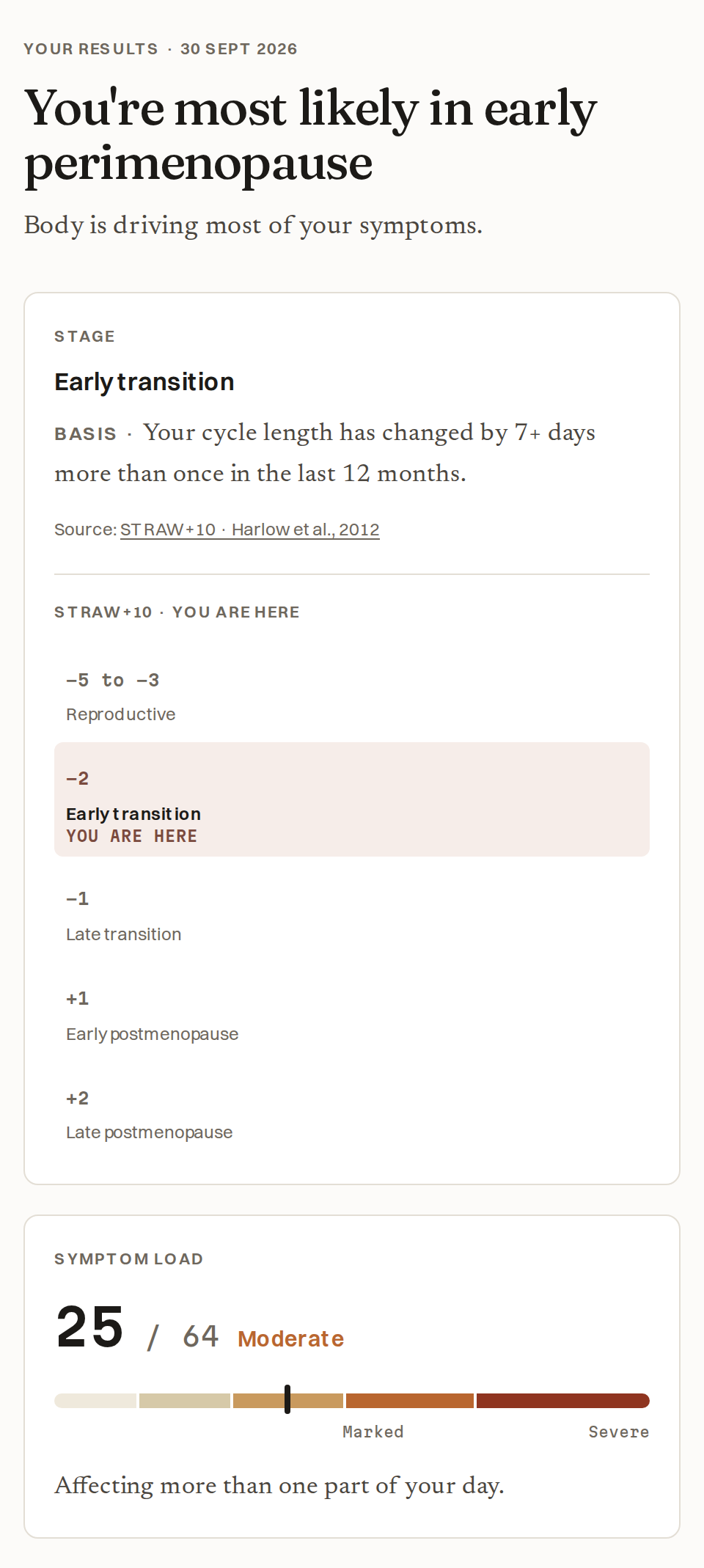
How the thyroid gland and menopause overlap
Why thyroid problems and perimenopause get mixed up
Your thyroid gland sets the pace of your metabolism, and when it runs too slow or too fast, the symptoms overlap with perimenopause: tiredness, weight change, mood changes, poor sleep, a racing heart and period changes. The US Office on Women's Health notes that thyroid symptoms are sometimes mistaken for menopause symptoms. Because one in eight women develops a thyroid problem, both are common at the same age.
Underactive thyroid (hypothyroidism) and perimenopause
An underactive thyroid makes too little thyroid hormone. The NHS lists tiredness, feeling cold, weight gain, constipation, trouble concentrating, low mood and hair loss, and the Office on Women's Health adds heavier periods. Symptoms come on gradually. The most common cause, Hashimoto's disease, is most common in women and usually starts between 30 and 50, and hypothyroidism becomes more likely after menopause. It's treated with levothyroxine tablets.
Overactive thyroid (hyperthyroidism) and hot flashes
An overactive thyroid can feel like perimenopause turned up: feeling hot, sweating more, trouble sleeping, anxiety, irritability and a fast or irregular heartbeat. The differences are weight loss despite eating normally, trembling hands and sometimes a swelling in the neck. It's about 10 times more common in women than men, and usually starts between 20 and 40. Menopause hot flashes come in waves lasting minutes; constant heat that doesn't come in waves is worth checking.
The TSH test: how thyroid problems are found
TSH, thyroid-stimulating hormone, is made by the pituitary gland to tell the thyroid how hard to work. When thyroid hormone is low, TSH rises; when thyroid hormone is high, TSH falls to little or none. That makes one blood test a good first check for both an underactive and an overactive thyroid. Doctors usually measure thyroxine (T4) alongside it to confirm the diagnosis.
Why a TSH test is useful when hormone tests aren't
From 45, NICE identifies perimenopause without lab tests and advises against estradiol and AMH tests for it, because those hormones swing from day to day. A thyroid test is different: it checks for a separate condition that can explain the same symptoms. So if you're tired, gaining weight or low in your 40s, a TSH test is worth asking for, while perimenopause is identified from your symptoms and cycle.
Thyroid disease and early menopause
Autoimmune thyroid disease can come with autoimmune damage to other glands, including the ovaries, and the Office on Women's Health lists it as a possible cause of menopause before 40. Autoimmune conditions such as thyroid disease are among the known causes of early menopause. If your periods stop before 40 and you have a thyroid condition, see a doctor to check for premature ovarian insufficiency.
HRT if you take thyroid medicine
Estrogen raises the level of thyroid-binding globulin, a protein that carries thyroid hormone in the blood. People with a healthy thyroid make up for it, but the FDA label for estradiol says that if you depend on thyroid hormone tablets, you may need a higher dose once you start estrogen, and your thyroid levels should be monitored. Tell your doctor you take levothyroxine when you start HRT.
You can have both
A thyroid problem doesn't rule out perimenopause, and perimenopause doesn't rule out a thyroid problem. Hypothyroidism becomes more likely after menopause, so a normal TSH at 42 doesn't mean it will stay normal. If thyroid treatment brings your levels into range and hot flashes or cycle changes continue, perimenopause is worth considering for those symptoms, and your cycle pattern becomes the useful signal.
When to get your thyroid checked
Tiredness, weight change and low mood that don't lift
Ask for a TSH blood test. It's a simple check for both an underactive and an overactive thyroid.
Weight loss with a fast heartbeat, trembling or a swelling in your neck
See a doctor. These point to an overactive thyroid rather than perimenopause.
You take levothyroxine and are starting estrogen
Ask for your thyroid levels to be checked after starting: you may need a higher dose.
Periods stop before 40
See a doctor. It may be premature ovarian insufficiency, which is more likely with autoimmune thyroid disease. More →
Very heavy periods
See a doctor. Heavy periods are common approaching menopause, but fibroids and other conditions cause them too, and blood tests can check for iron deficiency anemia.
Thyroid and menopause: questions women ask
Is it my thyroid or perimenopause?
A TSH blood test tells you whether your thyroid is involved. Symptoms alone can't: tiredness, weight change, low mood and poor sleep happen in both. Feeling cold points to an underactive thyroid; feeling hot with weight loss, to an overactive one; hot flashes in waves with a changing cycle, to perimenopause.
Can thyroid problems cause hot flashes?
An overactive thyroid can make you feel hot when others don't and sweat more, which can feel like hot flashes. An underactive thyroid usually does the opposite and makes you feel cold.
Can hypothyroidism cause night sweats?
Night sweats aren't a typical sign of an underactive thyroid, which more often makes you feel cold. Sweating and feeling hot are signs of an overactive thyroid. In your 40s, night sweats are also a common perimenopause symptom: 50% to 75% of women have hot flashes, night sweats or both during the transition.
Related →Does menopause cause thyroid problems?
Menopause doesn't cause them, but thyroid disease, especially hypothyroidism, is more likely to develop after menopause. That's one reason to repeat a TSH test if new symptoms appear.
Can thyroid disease cause early menopause?
It can. Autoimmune thyroid disease can come with autoimmune damage to the ovaries, and the Office on Women's Health lists it as a possible cause of menopause before 40.
Related →Can I take HRT with hypothyroidism?
Yes, an underactive thyroid isn't a reason to avoid HRT. Estrogen can raise the dose of thyroid hormone you need, so your levels should be checked after you start.
Related →What does a high TSH mean?
Usually an underactive thyroid: when thyroid hormone is low, the pituitary makes more TSH to push the thyroid to work harder. A low TSH usually means an overactive thyroid.
Should I get my thyroid checked in perimenopause?
If you have tiredness, weight change, low mood or heavier periods, yes: a TSH test is a simple way to rule a thyroid problem in or out, because the symptoms overlap and one in eight women develops one.
Will the stage check tell me if it's my thyroid?
No, only a blood test can. The check asks whether you've been told you have a thyroid condition, and your result lists thyroid among the things worth ruling out when your symptoms fit.
Sources
- US Office on Women's Health. Thyroid disease.
- MedlinePlus, US National Library of Medicine. TSH (thyroid-stimulating hormone) test.
- NHS. Underactive thyroid (hypothyroidism).
- NHS. Symptoms of menopause and perimenopause.
- NHS. Overactive thyroid (hyperthyroidism).
- NICE. Menopause: identification and management (NG23). Updated 2024.
- Harlow SD, Gass M, Hall JE, et al. Executive summary of the Stages of Reproductive Aging Workshop + 10. J Clin Endocrinol Metab. 2012;97(4):1159-1168.
- Office on Women's Health, US Department of Health and Human Services. Early or premature menopause.
- Prescribing information: Estradiol tablets USP. Teva Pharmaceuticals, 2024. DailyMed, US National Library of Medicine.
- Crandall CJ, Mehta JM, Manson JE. Management of Menopausal Symptoms: A Review. JAMA. 2023;329(5):405-420.
- NHS. Heavy periods.
- NHS. Irregular periods.
See our editorial policy.
Related checks
Related guides
Perimenopause fatigue
Tiredness that sleep doesn't fix is one of the most common perimenopause symptoms. Hormonal causes, blood test…
Menopause weight gain
Menopause speeds up fat gain and muscle loss, while weight rises mostly with age. Why it happens, and the diet…
Hot flashes
A hot flash is a sudden wave of heat, flushing and sweat that usually lasts a few minutes. Why they happen, co…
Early menopause symptoms
Menopause before 45 is early; before 40 it's premature (POI). Signs to watch, causes, tests, and why HRT until…