
Last checked September 2026 against 20 sources · Editorial policy
Am I in perimenopause? How to tell
You know you're in perimenopause when the length of your cycle starts varying by 7 days or more from one cycle to the next, or you go 60 days or more without a period, especially with new hot flashes, night sweats or poor sleep in your 40s. From 45, NICE identifies perimenopause from these signs, without blood tests.
- Free · about 2 minutes
- Your cycle, staged by STRAW+10
- 16 symptoms across heat, sleep, mood, focus and body
Perimenopause signs by the numbers
- McKinlay et al. 1992 ↗
47.5
median age at the start of perimenopause in the Massachusetts Women's Health Study.
- Harlow et al. 2012 ↗
7+ days
persistent difference in length between consecutive cycles marks the start of the transition.
- Hedges et al. 2026 ↗
83%
of women 35+ reported fatigue in a survey of 17,494 women, while hot flashes were the symptom most of them knew about.
- Cunningham et al. 2025 ↗
55.4%
of US women aged 30 to 35 had moderate or severe symptoms on a standard menopause scale in a survey of 4,432 women.
Surveys of app users show how common symptoms are, not whether each woman was in perimenopause; your cycle pattern is what stages the transition.
Am I in perimenopause? Expectation vs reality
What people often expect
“Perimenopause starts when my periods stop, or when a blood test says so”
What the evidence shows
Perimenopause starts years before periods stop: it begins with the early transition, when cycle length becomes variable, and ends 12 months after the final period. Periods usually change first, but hot flashes, poor sleep and mood changes can come before periods change much. And from 45, no blood test is needed: NICE identifies perimenopause from recently started hot flashes plus any change in your cycle.
Check if you're in perimenopause in 2 minutes
- 1
8 questions on your cycle
How regular your periods are, whether one cycle has been a week or more longer or shorter than the one before, and the longest gap in the last 12 months. This places you on STRAW+10: late reproductive, early transition, late transition or postmenopause.
- 2
16 symptoms, scored 0 to 4
How much each has affected you over the past 4 weeks, across heat, sleep, mood, focus and body. The total runs from 0 to 64.
- 3
Your result, free
Your stage with the reason for it, your symptom score, the area that leads, and what else is worth ruling out. Retake it in 90 days to see what changed.
- 4
Optional: a report for your doctor
One page for your appointment, built from your answers and daily log. The doctor-ready report and daily tracking come with a 7-day trial for $1, then $99 a year. Cancel anytime.
| 0–8 | Minimal | Few symptoms right now. |
|---|---|---|
| 9–18 | Mild | Noticeable, but not running your days. |
| 19–30 | Moderate | Affecting more than one part of your day. |
| 31–44 | Marked | Affecting several areas at once. |
| 45–64 | Severe | Heavy symptom load. |
Example result: age 44 · one cycle 9 days shorter than the one before, more than once · score 22, moderate · mood leads.
Start the free check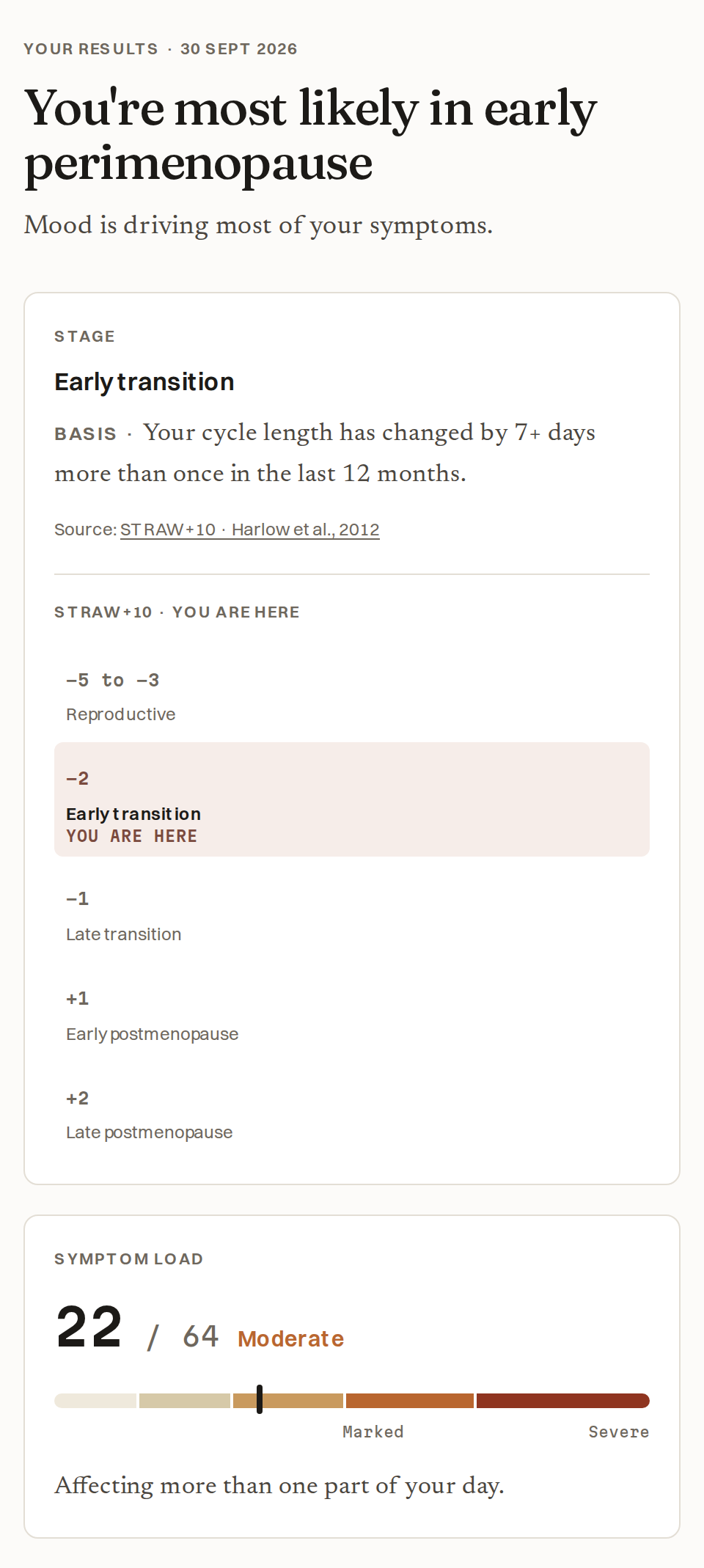
How to tell if you're in perimenopause: the signs
Your cycle length changes
The earliest reliable sign is a change in your cycle. STRAW+10, the staging system researchers and doctors use, marks the start of the early transition as a persistent difference of 7 days or more between the lengths of consecutive cycles, one that happens again within 10 cycles. Periods can also come more or less often, and bleeding can get heavier or lighter. A period tracker or calendar is the easiest way to spot it.
You start skipping periods
Once you go 60 days or more without a period, you've reached the late transition. Cycles vary more, hormone levels swing widely and many cycles don't release an egg. This stage lasts 1 to 3 years on average, and it's when hot flashes and night sweats are most likely. After 12 months with no period at all, you've reached menopause, dated to your last period.
New hot flashes or night sweats
Between 50% and 75% of women have hot flashes, night sweats or both during the transition. They're the sign doctors lean on most: from 45, NICE says perimenopause can be identified when hot flashes or night sweats have recently started and there's any change in your cycle, with no lab tests needed. Hot flashes and night sweats can also continue for years after the final period.
Sleep, mood and focus change
The NHS lists sleep problems, mood changes, anxiety, and trouble with memory and concentration among perimenopause symptoms, and they can start before your periods change much. In a survey of 17,494 women using the Flo app, those 35 and older most often reported fatigue (83%), physical and mental exhaustion (83%), irritability (80%) and low mood (77%), while hot flashes were the symptom most of them knew to expect.
Your age: when perimenopause usually starts
Perimenopause usually starts in your 40s: the median age at onset was 47.5 in the Massachusetts Women's Health Study, and menopause usually comes between 45 and 55. Symptoms can appear earlier: in a US survey, 55.4% of women aged 30 to 35 had moderate or severe symptoms on a standard scale. But periods that stop or become irregular before 40 need a doctor, to check for premature ovarian insufficiency.
Premenopause, perimenopause or menopause: which are you in?
Premenopause means your reproductive years, before any changes. At the end of that stage, cycles can become subtly shorter while they're still regular. Perimenopause starts with the early transition, when cycle length becomes variable, and ends 12 months after your final period. Menopause is a single point in time: 12 months with no period when you're not using hormonal contraception. Postmenopause is everything after it.
When your cycle can't tell you
If you use hormonal contraception, a hormonal IUD or HRT, the bleeding you have is shaped by the treatment, so your cycle can't show which stage you're in. NICE notes that menopause is hard to identify in women taking hormonal treatments, and after a hysterectomy it's identified from the type of symptoms instead. In that case your symptoms, especially new hot flashes, are the useful signal, and the check scores them for you.
What else can feel like perimenopause
New tiredness, low mood or period changes in your 40s often are perimenopause, but these common causes look the same and each has a simple test.
| Could be | Clues | Test |
|---|---|---|
| Pregnancy | A missed or late period, sore breasts, nausea, tiredness. | Pregnancy test |
| Underactive thyroid | Tiredness, feeling cold, weight gain, low mood, heavier periods. | TSH blood test |
| Iron deficiency anemia | Tiredness that rest doesn't fix, often with heavy periods. | Full blood count and ferritin |
| Hormonal contraception | Mini-pill, injection or hormonal IUD: bleeding follows the method, not your own cycle. | None, it's expected |
| Weight change, stress or heavy exercise | A big change in weight, a stressful stretch or a jump in training shortly before periods changed. | Doctor's assessment if it continues |
Pregnancy
A missed or late period, sore breasts, nausea, tiredness.
Test: Pregnancy test
Underactive thyroid
Tiredness, feeling cold, weight gain, low mood, heavier periods.
Test: TSH blood test
Iron deficiency anemia
Tiredness that rest doesn't fix, often with heavy periods.
Test: Full blood count and ferritin
Hormonal contraception
Mini-pill, injection or hormonal IUD: bleeding follows the method, not your own cycle.
Test: None, it's expected
Weight change, stress or heavy exercise
A big change in weight, a stressful stretch or a jump in training shortly before periods changed.
Test: Doctor's assessment if it continues
When to see a doctor about perimenopause signs
Periods stop or become irregular before 40
See a doctor. Premature ovarian insufficiency is diagnosed from symptoms and raised FSH on 2 blood samples 4 to 6 weeks apart, and it needs treatment. More →
Any bleeding after 12 months without a period
See a doctor. Bleeding after menopause always needs checking. More →
Very heavy periods, or bleeding between periods or after sex
See a doctor to rule out fibroids, polyps and other causes before putting it down to perimenopause.
Symptoms affecting your sleep, work or relationships
Talk to a doctor about treatment. From 45, you don't need a blood test first: your symptoms and cycle are enough. More →
Urgent: Low mood, anxiety or thoughts of harming yourself
Talk to your doctor. If you're thinking of harming yourself, call or text 988, or call 911 in an emergency.
How do I know if I'm in perimenopause? Questions women ask
How do I know if I'm in perimenopause?
Look at your cycle first: a persistent change of 7 days or more in cycle length marks the early transition, and gaps of 60 days or more the late transition. New hot flashes, night sweats, poor sleep or mood changes in your 40s add to the picture. From 45, that's enough for a doctor to identify perimenopause without tests.
What is usually the first sign of perimenopause?
For most women, a change in periods: they come more or less often, or get heavier or lighter. Sleep problems, mood changes and hot flashes can appear alongside, and sometimes before periods change much.
Related →How can you tell if you're starting menopause?
Menopause itself is confirmed only looking back: after 12 months with no period, if you're not using hormonal contraception. Before that, changing cycles and new symptoms mean you're in perimenopause, the transition leading up to it.
How do I know if I'm premenopausal?
Premenopausal means your periods are still regular and you haven't started the transition. At the end of this stage, cycles can get subtly shorter while staying regular. Once cycle length starts varying by 7 days or more, you've moved into perimenopause.
Can a blood test tell if I'm in perimenopause?
Not reliably. FSH and estradiol swing from day to day in perimenopause, so one result can look normal. From 45, NICE advises against hormone tests to identify perimenopause; between 40 and 45 an FSH test can help, and under 40 it's part of checking for premature ovarian insufficiency.
Related →Can you be in perimenopause with regular periods?
Early on, yes. Symptoms such as poor sleep or mood changes can start before periods change much, and in the stage just before the transition cycles can become subtly shorter while staying regular. Once cycle length varies by 7 days or more, the transition has started.
How long does perimenopause last?
About 4 years on average, often longer when it starts early. The late transition, once you're skipping periods for 60 days or more, lasts 1 to 3 years on average.
Related →Can I be in perimenopause at 35?
Symptoms at 35 are common: in a US survey, 55.4% of women aged 30 to 35 had moderate or severe symptoms on a standard scale. But perimenopause usually starts in your 40s, and periods that stop or become irregular before 40 should be checked by a doctor.
Related →Is this perimenopause check a diagnosis?
No. It places your cycle on the same staging system doctors use and scores your symptoms, so you can see where you likely are and bring that to your appointment. It's not a lab test or a diagnosis.
Is the check free?
Yes. The check and your result are free: your stage with the reason for it, your symptom score and the area that leads. The doctor-ready report and daily tracking come with a 7-day trial for $1, then $99 a year. Cancel anytime.
Sources
- Harlow SD, Gass M, Hall JE, et al. Executive summary of the Stages of Reproductive Aging Workshop + 10. J Clin Endocrinol Metab. 2012;97(4):1159-1168.
- NICE. Menopause: identification and management (NG23). Updated 2024.
- NHS. Symptoms of menopause and perimenopause.
- Crandall CJ, Mehta JM, Manson JE. Management of Menopausal Symptoms: A Review. JAMA. 2023;329(5):405-420.
- Avis NE, Crawford SL, Greendale G, et al. Duration of menopausal vasomotor symptoms over the menopause transition. JAMA Intern Med. 2015;175(4):531-9.
- Hedges MS, Hewings-Martin Y, Karam J, et al. Global perspectives on perimenopause: a digital survey of knowledge and symptoms using the Flo application. Menopause. 2026;33(7):789-798.
- McKinlay SM, Brambilla DJ, Posner JG. The normal menopause transition. Maturitas. 1992;14(2):103-15.
- NHS. What are menopause and perimenopause?
- Cunningham AC, Hewings-Martin Y, Wickham AP, et al. Perimenopause symptoms, severity, and healthcare seeking in women in the US. npj Women's Health. 2025.
- NHS. Irregular periods.
- NHS. Signs and symptoms of pregnancy.
- US Office on Women's Health. Thyroid disease.
- NHS. Tiredness and fatigue.
- NHS. Early or premature menopause.
- NHS. Postmenopausal bleeding.
- NHS. Heavy periods.
- Dreisler E, Frandsen CS, Ulrich L. Perimenopausal abnormal uterine bleeding. Maturitas. 2024;184:107944.
- NHS. When to take hormone replacement therapy (HRT).
- Federal Communications Commission. 988 Suicide & Crisis Lifeline.
- National 911 Program. 911.gov.
See our editorial policy.
Related checks
Related guides
Perimenopause
Perimenopause is the transition before your final period, usually starting in your 40s and lasting about 4 yea…
What age does perimenopause start?
Most women start perimenopause in their 40s; some notice changes in their late 30s. What sets your timing, the…
Irregular periods in perimenopause
Cycles that shift by 7+ days mark early perimenopause; gaps of 60+ days mark the late stage. What's normal, wh…
The stages of menopause
The '7 stages' idea isn't a medical model. Doctors use STRAW+10: late reproductive, early and late transition,…