
Last checked September 2026 against 16 sources · Editorial policy
Perimenopause or pregnant? How to tell the difference
Perimenopause or pregnant? Only a pregnancy test tells you: a missed period, sore breasts, tiredness and mood changes happen in both. Test from the first day of a missed period or, if your cycle is irregular, at least 21 days after unprotected sex. Hot flashes and night sweats point more to perimenopause, but don't rule out pregnancy.
- Pregnancy test first: it's the only way to know
- Then a free stage check · about 2 minutes
- Cycle pattern + 16 symptoms
Perimenopause or pregnancy: the numbers that matter
- NHS ↗
21 days
after unprotected sex is when to test if you don't know when your period is due.
- NHS ↗
4–6 weeks
into a pregnancy is when early signs usually start.
- Snyder et al. 2005 ↗
5–14 IU/L
hCG on a blood test can come from the pituitary gland, not a pregnancy, in some women over 40.
- Women's Health Concern, 2025 ↗
Until 55
is when contraception can be stopped, even if you still have occasional periods.
Pregnancy vs perimenopause symptoms compared
| Pregnancy | Perimenopause | |
|---|---|---|
| Periods | A missed period; sometimes light spotting around the time it's due (implantation bleeding). | Cycle length varies by 7 days or more, or gaps of 60 days or more; flow can get heavier or lighter. |
| Breasts | Tender and enlarged. | Can be tender with hormone changes around menopause. |
| Nausea | Nausea and vomiting, at any time of day. | Not a typical perimenopause symptom. |
| Energy | Extreme tiredness after normal activities. | Tiredness and trouble sleeping, worse with night sweats. |
| Mood | Mood changes. | Mood swings, low mood, irritability and anxiety. |
| Heat | Not a typical early sign. | Hot flashes and night sweats, the most characteristic sign. |
| Bladder | Peeing more often without pain; constipation. | Needing to pee more often; more urinary infections. |
| Taste, smell, appetite | Metallic taste, sensitivity to smells, cravings or loss of interest in usual foods. | Not typical. |
| Time course | Signs start around 4 to 6 weeks and build quickly. | Changes build over months to years. |
Periods
- Pregnancy
- A missed period; sometimes light spotting around the time it's due (implantation bleeding).
- Perimenopause
- Cycle length varies by 7 days or more, or gaps of 60 days or more; flow can get heavier or lighter.
Breasts
- Pregnancy
- Tender and enlarged.
- Perimenopause
- Can be tender with hormone changes around menopause.
Nausea
- Pregnancy
- Nausea and vomiting, at any time of day.
- Perimenopause
- Not a typical perimenopause symptom.
Energy
- Pregnancy
- Extreme tiredness after normal activities.
- Perimenopause
- Tiredness and trouble sleeping, worse with night sweats.
Mood
- Pregnancy
- Mood changes.
- Perimenopause
- Mood swings, low mood, irritability and anxiety.
Heat
- Pregnancy
- Not a typical early sign.
- Perimenopause
- Hot flashes and night sweats, the most characteristic sign.
Bladder
- Pregnancy
- Peeing more often without pain; constipation.
- Perimenopause
- Needing to pee more often; more urinary infections.
Taste, smell, appetite
- Pregnancy
- Metallic taste, sensitivity to smells, cravings or loss of interest in usual foods.
- Perimenopause
- Not typical.
Time course
- Pregnancy
- Signs start around 4 to 6 weeks and build quickly.
- Perimenopause
- Changes build over months to years.
Not everyone has all of these. No pattern of symptoms rules pregnancy in or out: a test does.
Perimenopause or pregnant? Expectation vs reality
What people often expect
“At my age, a missed period means perimenopause, and I can't get pregnant anyway”
What the evidence shows
A missed period is a common sign of both. In perimenopause, ovulation becomes irregular rather than stopping, and women still conceive in their late 40s and into their 50s. That's why UK menopause experts advise contraception until 2 years after your last period if you're under 50, 1 year if you're over 50, or until 55.
Not pregnant? Check your perimenopause stage
- 1
8 questions on your cycle
How regular your periods are, whether one cycle has been a week or more longer or shorter than the one before, and the longest gap in the last 12 months. This places you on STRAW+10: late reproductive, early transition, late transition or postmenopause.
- 2
16 symptoms, scored 0 to 4
How much each has affected you over the past 4 weeks, across heat, sleep, mood, focus and body. The total runs from 0 to 64.
- 3
Your result, free
Your stage with the reason for it, your symptom score, the area that leads, and what else is worth ruling out. Retake it in 90 days to see what changed.
- 4
Optional: a report for your doctor
One page for your appointment, built from your answers and daily log. The doctor-ready report and daily tracking come with a 7-day trial for $1, then $99 a year. Cancel anytime.
| 0–8 | Minimal | Few symptoms right now. |
|---|---|---|
| 9–18 | Mild | Noticeable, but not running your days. |
| 19–30 | Moderate | Affecting more than one part of your day. |
| 31–44 | Marked | Affecting several areas at once. |
| 45–64 | Severe | Heavy symptom load. |
Example result: age 45 · negative pregnancy test · one cycle 10 days longer than the one before, more than once · score 19, moderate · sleep leads.
Start the free check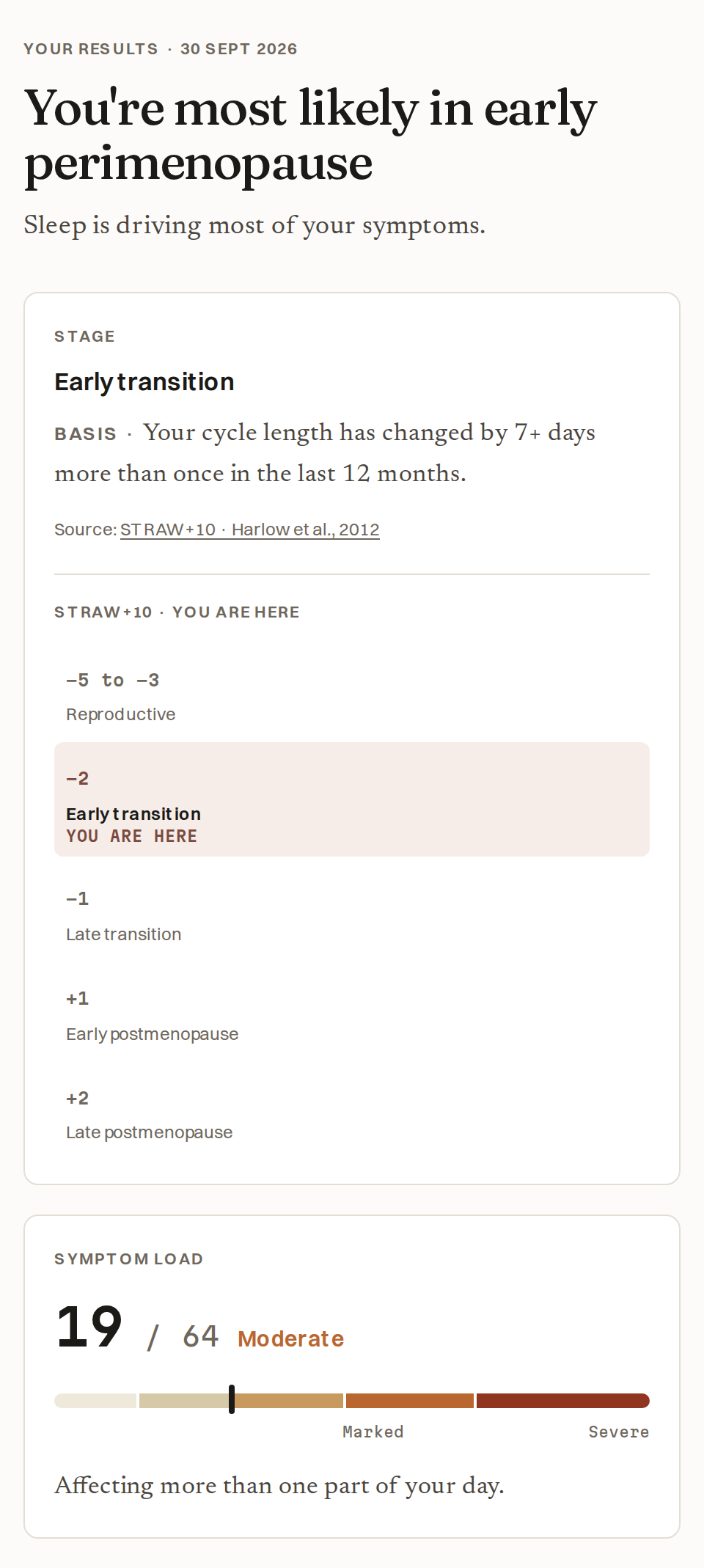
How to tell perimenopause from pregnancy
Why perimenopause and pregnancy are easy to confuse
Both change your hormones, and both can start with a late or missed period. In perimenopause, estrogen swings high and low while progesterone falls as ovulation becomes irregular. The result can be sore breasts, tiredness, poor sleep and mood changes, and the NHS lists sore breasts, tiredness and mood changes among early signs of pregnancy too. Because both can happen at the same age, you can't tell them apart by how you feel.
How to take a pregnancy test when your periods are irregular
Home tests detect hCG, a hormone made from around 6 days after fertilization. The NHS says you can test from the first day of a missed period, but if your cycle is irregular and you don't know when it's due, wait at least 21 days after you last had unprotected sex. A positive result is almost certainly correct. A negative one is less reliable: test again after a few days.
Can perimenopause cause a positive pregnancy test?
Rarely, and mainly on blood tests. Around and after menopause, the pituitary gland can make small amounts of hCG, and blood levels of 5 to 14 IU/L have been found in women who weren't pregnant. Doctors can check FSH to tell them apart: in one study, pregnancy was unlikely in women 41 to 55 with hCG in that range if FSH was above 20 IU/L. A clearly positive home test still means see a doctor.
Signs that point to perimenopause
A pattern over months points to perimenopause: cycle length varying by 7 days or more from one cycle to the next, gaps of 60 days or more, and new hot flashes or night sweats. Perimenopause usually starts in your 40s, at a median age of 47.5 in one large study. From 45, NICE identifies it from recently started hot flashes plus any change in your cycle, once pregnancy is ruled out.
Signs that point to pregnancy
Early pregnancy signs usually start 4 to 6 weeks in and build quickly. The NHS lists a missed period, light spotting around when it's due, nausea at any time of day, extreme tiredness, tender and enlarged breasts, peeing more often, constipation, more vaginal discharge, a metallic taste, sensitivity to smells and changes in appetite. A metallic taste and a new sensitivity to smells aren't typical of perimenopause.
You can still get pregnant in perimenopause
Some cycles release an egg and some don't, and a cycle can ovulate after months without a period. Fertility falls gradually from about 32 and faster after 37, so pregnancy is less likely, but women still conceive in their late 40s and into their 50s. If you don't want to get pregnant, keep using contraception until menopause is confirmed. HRT isn't contraception.
Pregnancy after menopause
Once menopause is confirmed, natural pregnancy is no longer expected: that's 12 months without a period if you're over 50, or 2 years if you're under 50. If your contraception stops your periods and you can't tell, you can stop it at 55. After menopause, bleeding isn't a period or a sign of pregnancy: it always needs checking by a doctor.
When to see a doctor: pregnancy or perimenopause
A positive pregnancy test
See a doctor or midwife early. Pregnancy after 40 needs closer monitoring, and if it wasn't planned, a doctor can talk through all your options. More →
Two negative tests and still no period
See a doctor, as the NHS advises when a period still hasn't come after a second negative test. They can look at other causes of missed periods.
Periods stop before 40
See a doctor once pregnancy is ruled out: it may be premature ovarian insufficiency, which needs treatment. More →
Any bleeding after 12 months without a period
See a doctor. Bleeding after menopause always needs checking. More →
Perimenopause or pregnant: questions women ask
Is it perimenopause or am I pregnant?
Take a pregnancy test: it's the only way to know. A missed period, sore breasts, tiredness and mood changes happen in both. Hot flashes and night sweats point more to perimenopause, and a metallic taste or new sensitivity to smells more to pregnancy.
Can perimenopause cause a positive pregnancy test?
Rarely. Around and after menopause the pituitary gland can make small amounts of hCG, which can show up on a blood test at 5 to 14 IU/L. A doctor can check FSH to tell pituitary hCG from pregnancy. Treat a clearly positive home test as pregnancy until a doctor says otherwise.
Can menopause give a false positive pregnancy test?
After menopause, low levels of hCG from the pituitary gland are a known finding on blood tests and aren't a sign of pregnancy or of anything harmful on their own. In women over 55, one study suggested reading blood hCG up to 14 IU/L as normal.
When should I take a pregnancy test if my periods are irregular?
At least 21 days after you last had unprotected sex, since you can't count from a missed period. If it's negative and your period still doesn't come, test again after a few days.
Can you get pregnant during perimenopause?
Yes. Ovulation becomes irregular rather than stopping, and women still conceive in their late 40s and into their 50s. Use contraception until 2 years after your last period if you're under 50, 1 year if you're over 50, or until 55.
Related →Do perimenopause symptoms feel like early pregnancy?
They can. Sore breasts, tiredness and mood changes are early pregnancy signs and also happen in perimenopause. Nausea, a metallic taste and new sensitivity to smells point more to pregnancy. The time course differs too: pregnancy signs build over weeks, perimenopause changes over months.
What are the signs of pregnancy after menopause?
Once menopause is confirmed, natural pregnancy isn't expected. If you have bleeding after 12 months without a period, it isn't a sign of pregnancy, and it needs checking by a doctor.
Is it perimenopause or pregnancy at 47?
Either is possible at 47. Perimenopause is more common at that age, with a median start of 47.5 in one large study, but pregnancy is still possible until menopause is confirmed. Take a pregnancy test first.
Can this check tell me if I'm pregnant?
No. Take a pregnancy test first. If it's negative, the check places your cycle on the staging system doctors use and scores your symptoms, so you can see whether perimenopause fits.
Sources
- NHS. Doing a pregnancy test.
- NHS. Signs and symptoms of pregnancy.
- NHS. Irregular periods.
- Prior JC. Progesterone for Symptomatic Perimenopause Treatment - Progesterone politics, physiology and potential for perimenopause. Facts Views Vis Obgyn. 2011;3(2):109-20.
- Women's Health Concern (British Menopause Society). Contraception for women over the age of 40. Fact sheet, 2025.
- NHS. Symptoms of menopause and perimenopause.
- NHS. Breast pain.
- Snyder JA, Haymond S, Parvin CA, et al. Diagnostic considerations in the measurement of human chorionic gonadotropin in aging women. Clin Chem. 2005;51(10):1830-5.
- Gronowski AM, Fantz CR, Parvin CA, et al. Use of serum FSH to identify perimenopausal women with pituitary hCG. Clin Chem. 2008;54(4):652-6.
- El Hage L, Hatipoglu B. Elevated hCG can be a benign finding in perimenopausal and postmenopausal women. Cleve Clin J Med. 2021;88(11):635-639.
- Harlow SD, Gass M, Hall JE, et al. Executive summary of the Stages of Reproductive Aging Workshop + 10. J Clin Endocrinol Metab. 2012;97(4):1159-1168.
- McKinlay SM, Brambilla DJ, Posner JG. The normal menopause transition. Maturitas. 1992;14(2):103-15.
- NICE. Menopause: identification and management (NG23). Updated 2024.
- American College of Obstetricians and Gynecologists Committee on Gynecologic Practice and Practice Committee. Female age-related fertility decline. Committee Opinion No. 589. Fertil Steril. 2014;101(3):633-4.
- NHS. Postmenopausal bleeding.
- NHS. Early or premature menopause.
See our editorial policy.
Related checks
Related guides
Can you get pregnant during perimenopause?
Yes. Ovulation becomes irregular but doesn't stop until menopause. How likely pregnancy is by age, signs that …
Birth control in perimenopause
You can still get pregnant until 12 months without a period (2 years if under 50). Which pills, IUDs and patch…
Irregular periods in perimenopause
Cycles that shift by 7+ days mark early perimenopause; gaps of 60+ days mark the late stage. What's normal, wh…
Sore breasts in perimenopause
Estrogen spikes in perimenopause can make breasts sore, swollen or lumpy. How it differs from PMS, what eases …
Bleeding after menopause
Any bleeding 12+ months after your last period needs a doctor's check. Common causes (atrophy, polyps, HRT), l…