
Last checked September 2026 against 17 sources · Editorial policy
Do I need HRT? Signs it's worth asking your doctor
The main signs that you need hormone replacement therapy are hot flashes or night sweats that disrupt your sleep, work or daily life: NICE says to offer HRT for them. It's also worth discussing for low mood that began with other menopause symptoms, and it's advised after menopause before 45. For vaginal dryness alone, vaginal estrogen comes first.
- Free · about 2 minutes
- Your symptom score across heat, sleep, mood, focus and body
- A summary to take to your doctor
HRT by the numbers
- Crandall et al. 2023 ↗
75%
fewer hot flashes with systemic estrogen, alone or with a progestogen.
- Crandall et al. 2023 ↗
50–75%
of women have hot flashes, night sweats or both during the menopause transition.
- The North American Menopause Society, 2022 ↗
Under 60
or within 10 years of menopause, the benefits of HRT outweigh the risks for most healthy women.
- NHS ↗
5 per 1,000
extra breast cancer cases in women taking combined HRT for 5 years.
HRT and other treatments compared
| Option | Good for | Watch for |
|---|---|---|
HRT (estrogen, plus a progestogen if you have a uterus) | Most effective, about 75% fewer hot flashes. Also helps sleep, mood and vaginal dryness, and prevents bone loss. Patches and gels avoid the clot risk of tablets. | Not for women with breast cancer, liver disease or a past clot on tablets. Combined HRT adds about 5 breast cancer cases per 1,000 women over 5 years. |
Vaginal estrogen | First choice for dryness, painful sex and urinary symptoms. Minimal amount reaches the bloodstream, and it can be used with HRT. | Treats local symptoms only, not hot flashes. Symptoms often return when it's stopped. |
Fezolinetant (Veozah) | Non-hormonal tablet that targets the brain signal behind hot flashes; NICE recommends it when HRT is unsuitable. | Boxed warning for rare serious liver injury; liver blood tests before starting and during the first months. |
Elinzanetant (Lynkuet) | Non-hormonal capsules taken at bedtime, approved in the US in 2025. | Can cause sleepiness, headache and fatigue. Liver tests before starting. |
Low-dose paroxetine and other SSRIs or SNRIs | Paroxetine 7.5 mg is FDA-approved for hot flashes; venlafaxine and escitalopram are alternatives that can also help mood. | NICE doesn't recommend them as first-line treatment for hot flashes alone. Paroxetine is usually avoided with tamoxifen. |
Menopause-specific CBT | No medicine. NICE suggests it for hot flashes, and for waking at night and low mood that come with them. | Helps you cope with hot flashes more than it reduces how often they come. |
HRT (estrogen, plus a progestogen if you have a uterus)
Good for
Most effective, about 75% fewer hot flashes. Also helps sleep, mood and vaginal dryness, and prevents bone loss. Patches and gels avoid the clot risk of tablets.Watch for
Not for women with breast cancer, liver disease or a past clot on tablets. Combined HRT adds about 5 breast cancer cases per 1,000 women over 5 years.Vaginal estrogen
Good for
First choice for dryness, painful sex and urinary symptoms. Minimal amount reaches the bloodstream, and it can be used with HRT.Watch for
Treats local symptoms only, not hot flashes. Symptoms often return when it's stopped.Fezolinetant (Veozah)
Good for
Non-hormonal tablet that targets the brain signal behind hot flashes; NICE recommends it when HRT is unsuitable.Watch for
Boxed warning for rare serious liver injury; liver blood tests before starting and during the first months.Elinzanetant (Lynkuet)
Good for
Non-hormonal capsules taken at bedtime, approved in the US in 2025.Watch for
Can cause sleepiness, headache and fatigue. Liver tests before starting.Low-dose paroxetine and other SSRIs or SNRIs
Good for
Paroxetine 7.5 mg is FDA-approved for hot flashes; venlafaxine and escitalopram are alternatives that can also help mood.Watch for
NICE doesn't recommend them as first-line treatment for hot flashes alone. Paroxetine is usually avoided with tamoxifen.Menopause-specific CBT
Good for
No medicine. NICE suggests it for hot flashes, and for waking at night and low mood that come with them.Watch for
Helps you cope with hot flashes more than it reduces how often they come.
Do I need HRT? Expectation vs reality
What people often expect
“I should only consider HRT once my symptoms are unbearable, and I need a blood test to prove I'm in menopause first”
What the evidence shows
The NHS says you don't have to wait until symptoms are severe or your periods stop, and from 45 NICE identifies perimenopause without blood tests. What decides it is how much your symptoms affect your life, weighed against your own risks. For healthy women under 60 or within 10 years of menopause, the benefits of HRT outweigh the risks.
Check your symptoms before you ask about HRT
- 1
8 questions on your cycle
How regular your periods are, whether one cycle has been a week or more longer or shorter than the one before, and the longest gap in the last 12 months. This places you on STRAW+10: late reproductive, early transition, late transition or postmenopause.
- 2
16 symptoms, scored 0 to 4
How much each has affected you over the past 4 weeks, across heat, sleep, mood, focus and body. The total runs from 0 to 64.
- 3
Your result, free
Your stage with the reason for it, your symptom score, the area that leads, and what else is worth ruling out. Retake it in 90 days to see what changed.
- 4
Optional: a report for your doctor
One page for your appointment, built from your answers and daily log. The doctor-ready report and daily tracking come with a 7-day trial for $1, then $99 a year. Cancel anytime.
| 0–8 | Minimal | Few symptoms right now. |
|---|---|---|
| 9–18 | Mild | Noticeable, but not running your days. |
| 19–30 | Moderate | Affecting more than one part of your day. |
| 31–44 | Marked | Affecting several areas at once. |
| 45–64 | Severe | Heavy symptom load. |
Example result: age 49 · late transition, 60+ days without a period · score 34, marked · heat leads, sleep follows.
Start the free check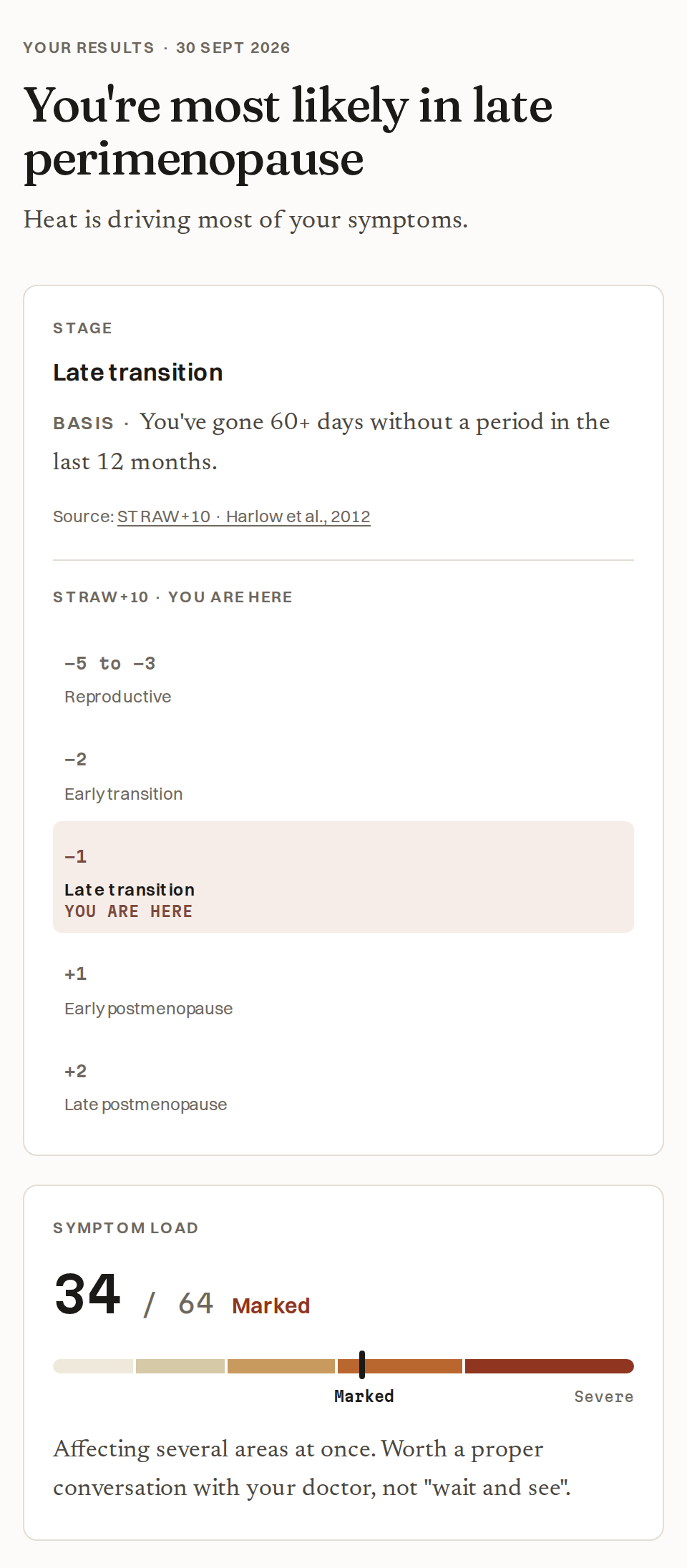
Signs you may need hormone replacement therapy
Hot flashes and night sweats that disrupt your life
This is the clearest sign. NICE tells doctors to offer HRT to women with hot flashes and night sweats associated with menopause, and systemic estrogen cuts their frequency by about 75%, more than any other treatment. If hot flashes wake you at night, leave you drenched at work or make you avoid situations, that's reason enough to ask. You don't need to wait until they're severe.
Sleep broken by night sweats
When night sweats wake you, poor sleep drags down your energy, mood and focus the next day. HRT helps sleep problems caused by menopause, and it reduces the night sweats that often cause them. NICE also suggests menopause-specific cognitive behavioral therapy (CBT) for waking at night that comes with hot flashes, either alongside HRT or instead of it if HRT isn't suitable or you'd rather not take it.
Low mood or anxiety that began with menopause
NICE says to consider HRT for depressive symptoms that started around the same time as other menopause symptoms, when they don't meet the criteria for depression. CBT is another option, alone or alongside. If you've been diagnosed with depression, or your doctor suspects it, it's treated as depression, with menopause taken into account. If you have thoughts of harming yourself, call or text 988.
Vaginal dryness, painful sex or urinary symptoms
For these, NICE says to offer vaginal estrogen, including to women already on HRT. It comes as a cream, gel, tablet, pessary or ring, and so little reaches the bloodstream that it's unlikely to have a significant effect on the rest of the body. Symptoms often come back when it's stopped, but it can be restarted. Non-hormonal moisturizers and lubricants can be used with it or instead.
Menopause before 45
If your periods stop before 45, hormone treatment isn't just for symptoms: it protects your bones and heart. Under 40, NICE says to offer HRT or a combined hormonal contraceptive to women with premature ovarian insufficiency unless there's a reason not to, such as a hormone-sensitive cancer. After early menopause, HRT is usually advised until at least the average age of menopause, about 51.
Low sex drive
Low sex drive is common around menopause, and the NHS lists falling hormone levels during menopause among its causes, with HRT among the treatments. If HRT alone doesn't help, NICE says doctors can consider adding testosterone; in the UK this is prescribed off-label for women. If sex is painful because of vaginal dryness, vaginal estrogen treats that directly, and it can be used alongside HRT.
What HRT isn't for
HRT prevents bone loss and fractures, which matters most after early menopause. But NICE says not to offer it to prevent heart disease or dementia, so those aren't reasons to start. It isn't contraception either: if you still have periods, you need contraception until 2 years after your last period if you're under 50, or 1 year if you're over 50, or until 55.
When HRT may not be right for you
HRT may not be suitable if you've had breast, ovarian or uterine cancer, have liver disease, or have high blood pressure that isn't controlled yet. If you've had a blood clot, patches or gels are usually used instead of tablets, because estrogen through the skin doesn't raise clot risk. If HRT isn't an option, NICE says to consider referral to a menopause specialist, and non-hormonal treatments exist.
Before you ask your doctor about HRT
- List your symptoms and how they affect your sleep, work and relationships. From 45, that's what the decision rests on, not a blood test.
- Note the date of your last period and how your cycle has changed: it decides between sequential HRT, with a monthly bleed, and continuous HRT.
- Bring your personal and family history of breast cancer, blood clots, stroke, liver disease and high blood pressure.
- Ask whether a patch or gel suits you better than tablets: estrogen through the skin doesn't raise the risk of clots.
- Plan contraception if you still have periods: HRT doesn't prevent pregnancy.
- Expect a review after 3 months, when most side effects have settled and the dose can be adjusted.
When to talk to a doctor about HRT
Menopause symptoms affecting your sleep, work or relationships
Talk to a doctor about HRT. If you're 45 or over, you usually won't need blood tests to start.
Periods stopped before 45
See a doctor. Hormone treatment until at least the average age of menopause protects your bones and heart. More →
You've been told HRT isn't safe for you
Ask about referral to a menopause specialist and about non-hormonal treatments. More →
Any bleeding after 12 months without a period
See a doctor before starting HRT. Bleeding after menopause always needs checking. More →
Urgent: Low mood, anxiety or thoughts of harming yourself
Talk to your doctor. If you're thinking of harming yourself, call or text 988, or call 911 in an emergency.
Do I need HRT? Questions women ask
What are the signs that you need hormone replacement therapy?
Hot flashes or night sweats that disrupt your sleep, work or daily life are the main one. Others are low mood that began with other menopause symptoms, and menopause before 45, when HRT protects bones and heart. Vaginal dryness alone is usually treated with vaginal estrogen.
How do you know if you need HRT?
Ask how much your symptoms affect your life, not whether they're severe enough. The NHS says you don't need to wait until symptoms are severe or periods stop. A doctor then weighs that against your personal risks, such as a history of breast cancer or blood clots.
Do I need a blood test before starting HRT?
Usually not if you're 45 or over: NICE says to identify perimenopause and menopause from symptoms and your cycle, without lab tests. Under 45, an FSH blood test may be used.
Related →Can I start HRT in perimenopause?
Yes. You don't have to wait until your periods stop. While you still have periods, you'll usually take sequential HRT, which brings a monthly bleed.
Related →Am I too old for HRT?
For healthy women under 60 or within 10 years of menopause, the benefits usually outweigh the risks. Starting later is a more individual decision, weighed with your doctor against your own risks.
What if I can't take HRT?
Non-hormonal prescriptions include fezolinetant, elinzanetant, low-dose paroxetine and other SSRIs or SNRIs, and gabapentin. Menopause-specific CBT helps too. Over-the-counter supplements haven't been shown to work for hot flashes.
Related →How long does HRT take to work?
Symptoms usually improve within days to weeks, and most side effects settle within 3 months, when you'll normally have your first review.
Is there a "do I need HRT" quiz?
This check works as one: it stages your cycle and scores 16 symptoms, shows which area leads, and gives you a summary to take to your doctor. Whether HRT suits you is decided with your doctor.
Is the check free?
Yes. The check and your result are free. The doctor-ready report and daily tracking come with a 7-day trial for $1, then $99 a year. Cancel anytime.
Sources
- NICE. Menopause: identification and management (NG23). Updated 2024.
- NHS. When to take hormone replacement therapy (HRT).
- The North American Menopause Society. The 2022 hormone therapy position statement of The North American Menopause Society. Menopause. 2022;29(7):767-794.
- Crandall CJ, Mehta JM, Manson JE. Management of Menopausal Symptoms: A Review. JAMA. 2023;329(5):405-420.
- Federal Communications Commission. 988 Suicide & Crisis Lifeline.
- NHS. Early or premature menopause.
- NHS. Low sex drive (loss of libido).
- Women's Health Concern (British Menopause Society). Contraception for women over the age of 40. Fact sheet, 2025.
- NHS. About hormone replacement therapy (HRT).
- NHS. Benefits and risks of hormone replacement therapy (HRT).
- NHS. Postmenopausal bleeding.
- National 911 Program. 911.gov.
- Prescribing information: Veozah (fezolinetant tablets). Astellas Pharma, 2026. DailyMed, US National Library of Medicine.
- Prescribing information: Lynkuet (elinzanetant capsules). Bayer HealthCare, 2026. DailyMed, US National Library of Medicine.
- Prescribing information: Brisdelle (paroxetine 7.5 mg capsules). Legacy Pharma, 2025. DailyMed, US National Library of Medicine.
- The North American Menopause Society. The 2023 nonhormone therapy position statement of The North American Menopause Society. Menopause. 2023;30(6):573-590.
- NHS. Types of hormone replacement therapy (HRT).
See our editorial policy.
Related checks
Related guides
HRT
What HRT is, who it's for, estrogen and progesterone options (patch, gel, pill), benefits, real risks by age, …
HRT for perimenopause
You don't have to wait until periods stop to start HRT. Which regimens suit perimenopause (cyclical vs continu…
Hot flash treatment
HRT is the most effective hot flash treatment. Non-hormonal options include fezolinetant, SSRIs, gabapentin an…
Online HRT providers compared
Telehealth menopause clinics compared by price, insurance, prescriptions offered and wait times. What to check…
Early menopause symptoms
Menopause before 45 is early; before 40 it's premature (POI). Signs to watch, causes, tests, and why HRT until…