
12-Week Strength Plan for Perimenopause and Menopause
$27 · personalized PDF · ready in a minute · 30-day refund
Built around your stage, your equipment and any joints or bones you need to work around. Two or three sessions a week, 30 to 45 minutes each.
Both plans: this one and the 28-day meal plan, save $15. You see week 1 before you pay.
What you get
- 12 weeks in three phases: Foundation, Build and Strength
- 24 to 36 strength sessions of 30 to 45 minutes
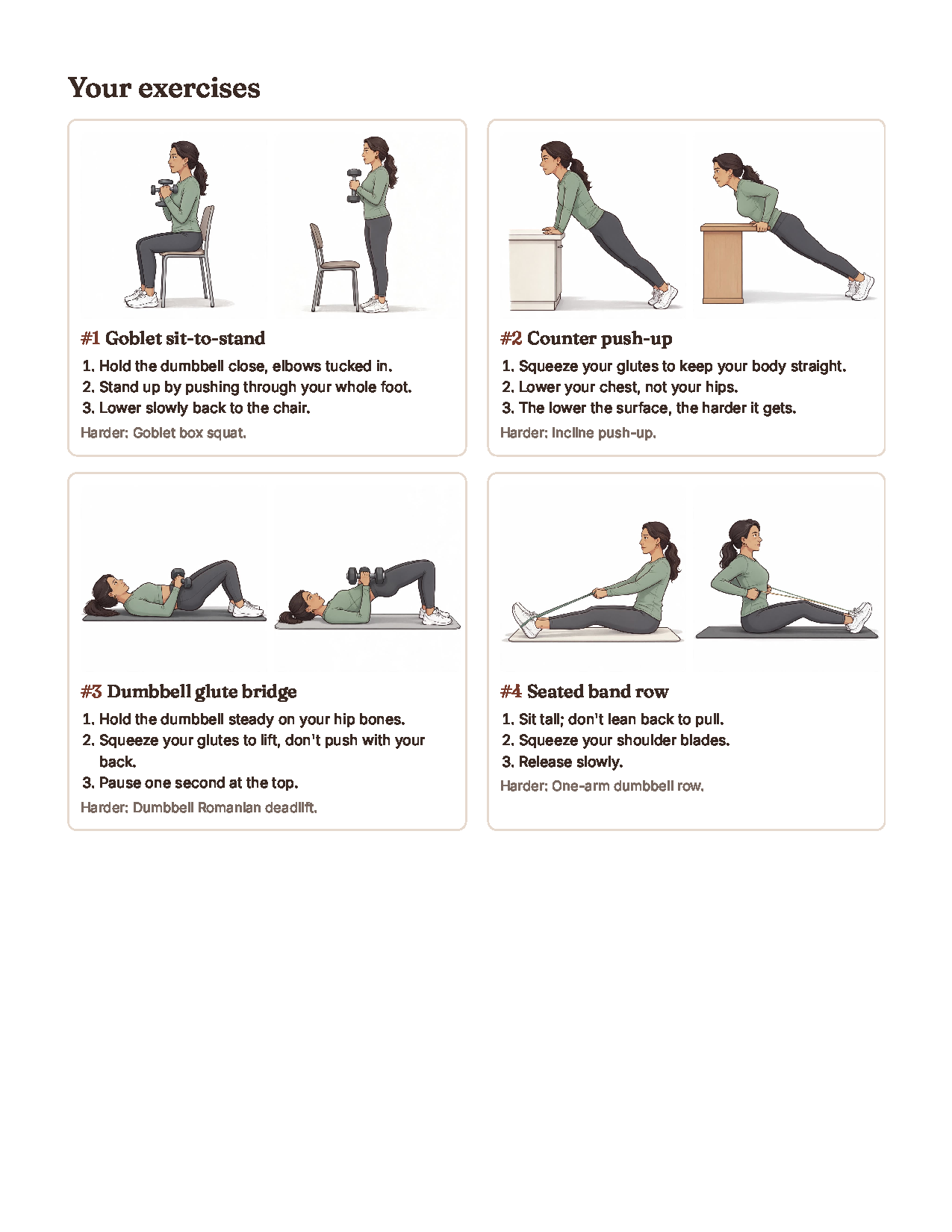
- Your exercises with illustrations, three technique cues each, and an easier and a harder version
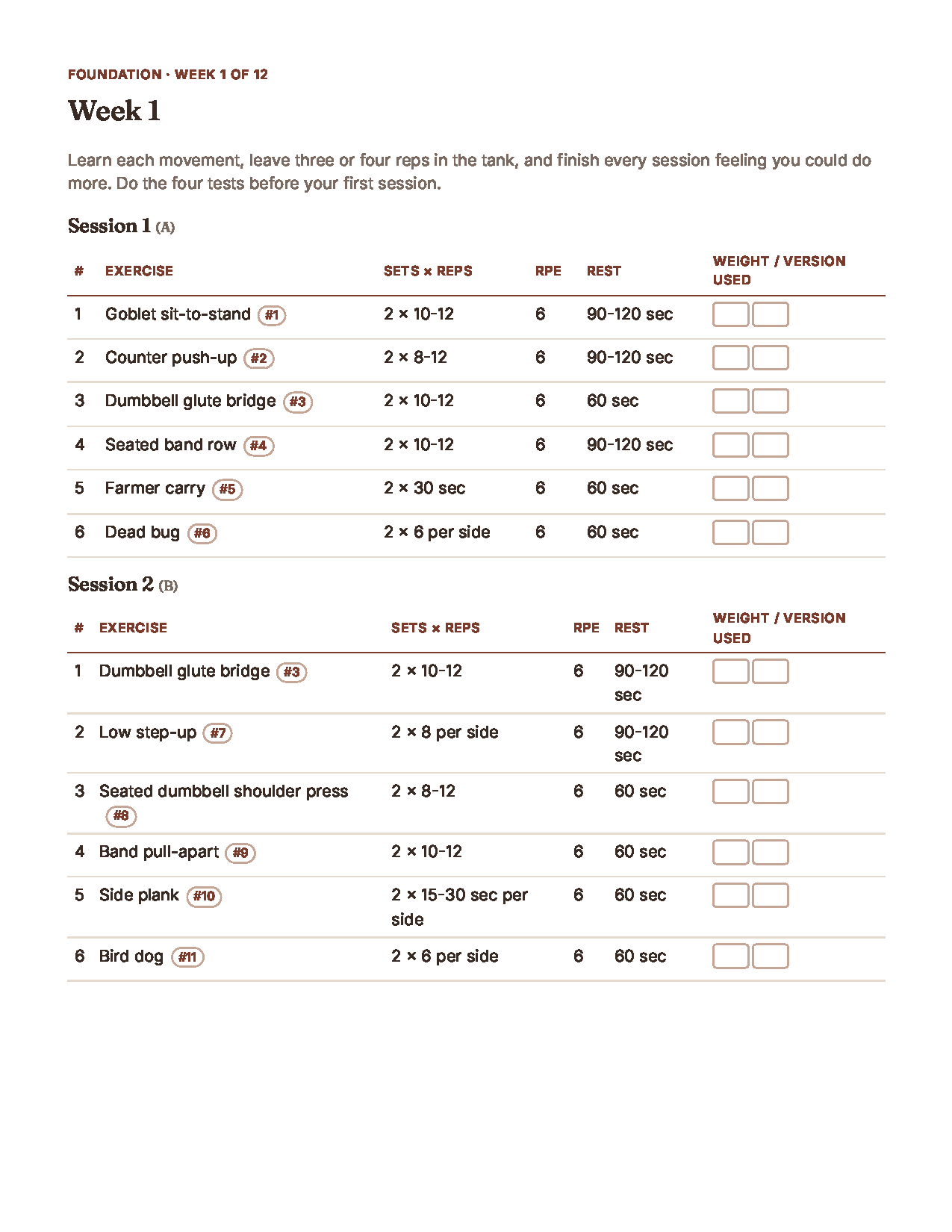
- Versions for home with no equipment, home with bands and dumbbells, or a gym
- Adjustments for knee, back or shoulder pain, bladder leaks and osteoporosis
- Walking targets that build to 150 minutes a week
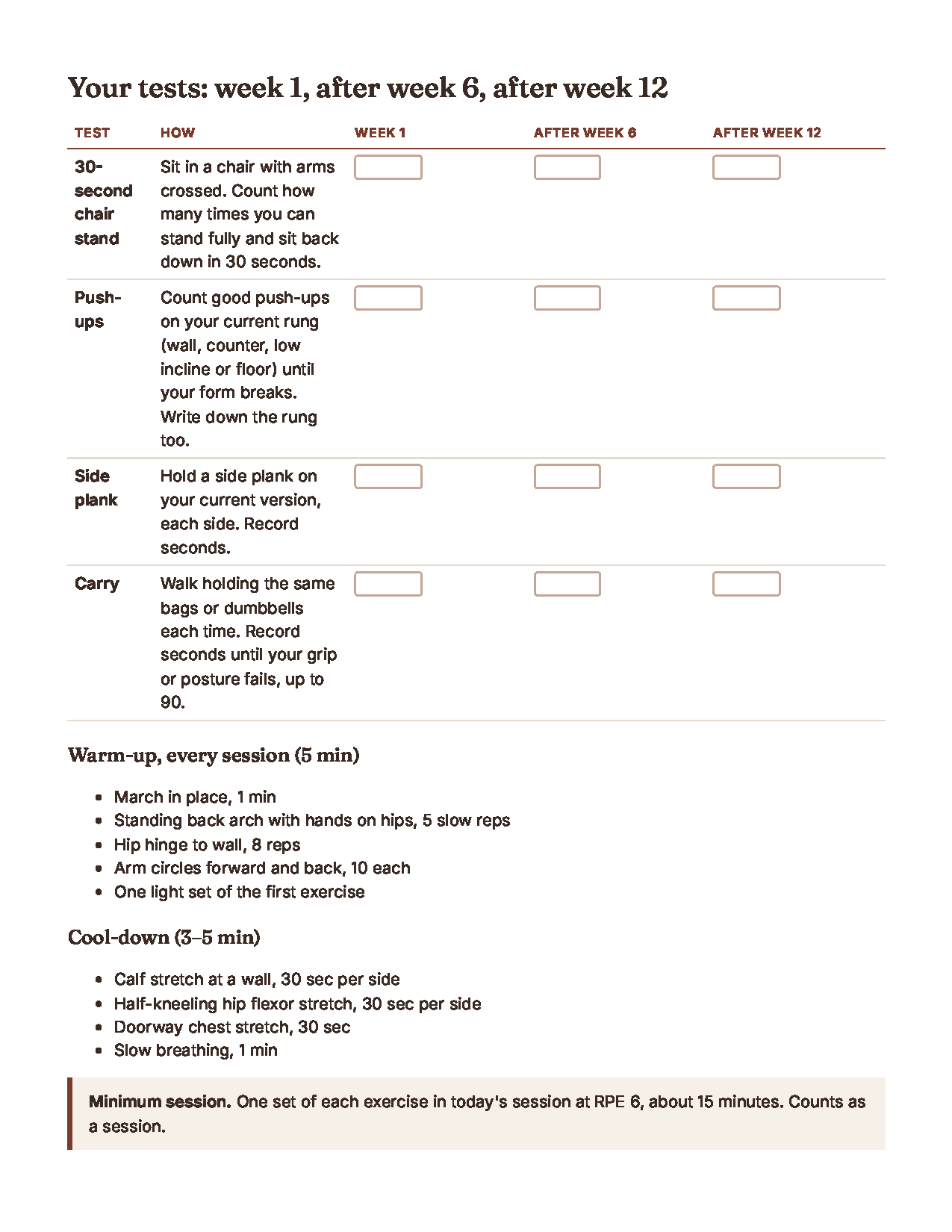
- Strength tests in week 1, after week 6 and after week 12, and a progress log
- A bad-day plan for poor sleep, hot flashes, heavy periods and sore joints
Inside your plan
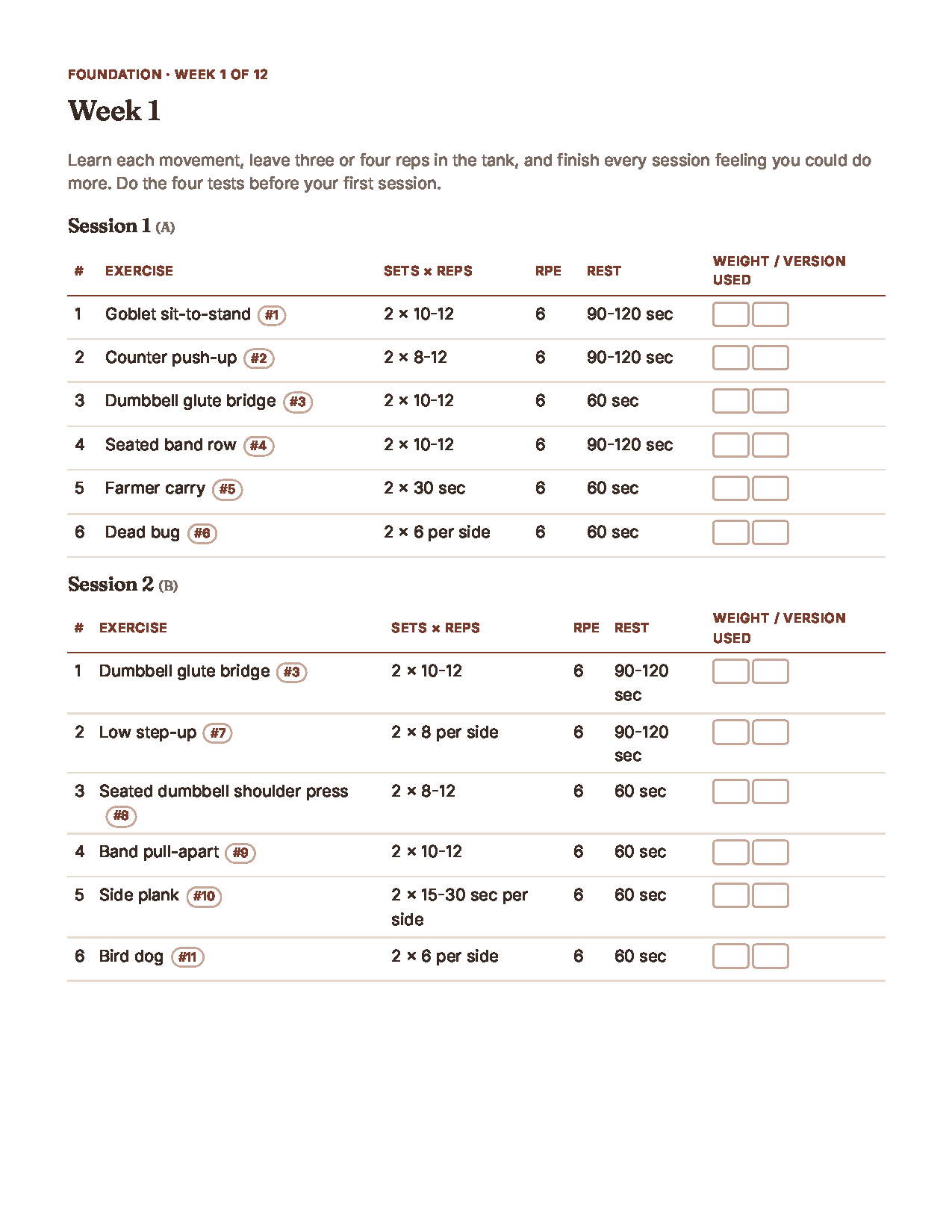
Every week on one page
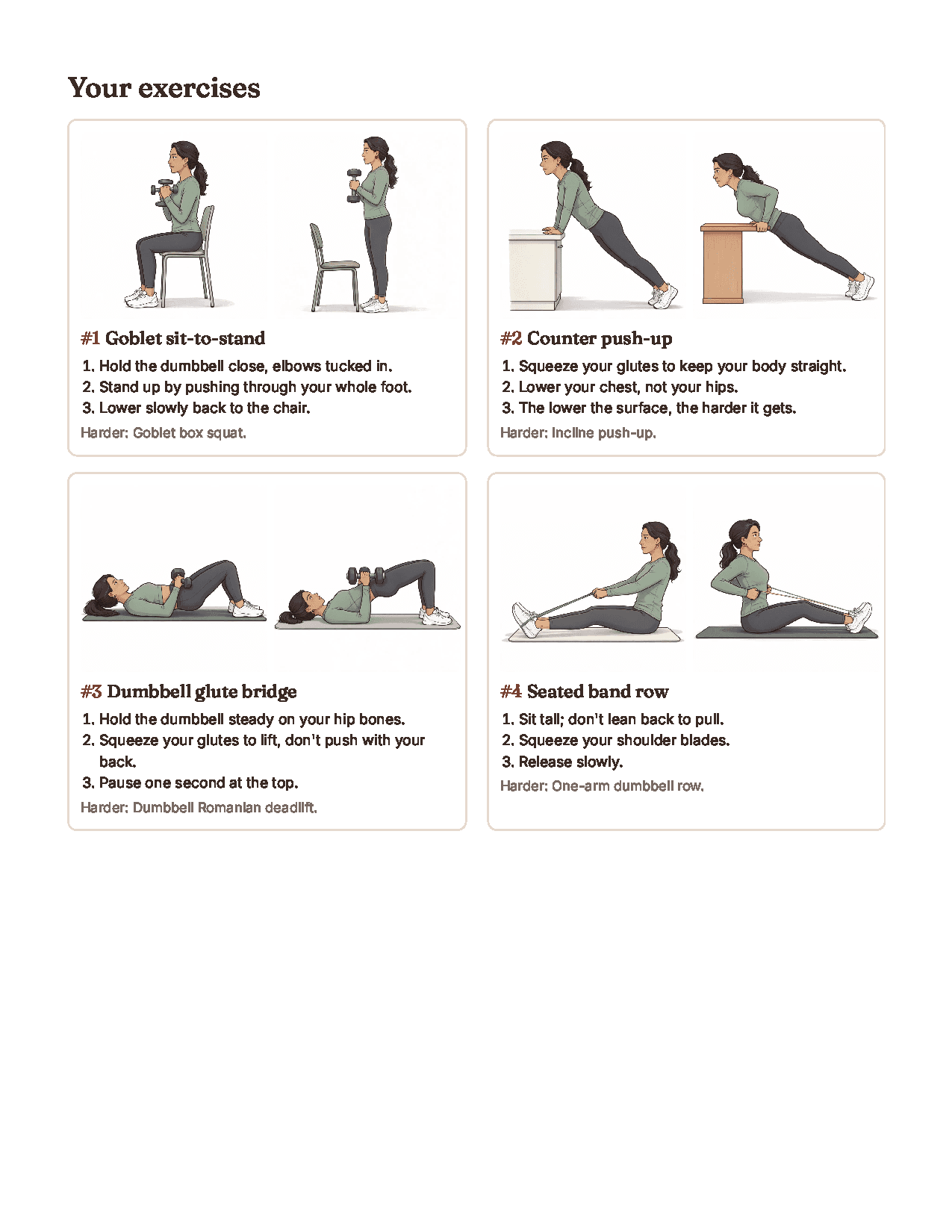
Your exercises, with pictures
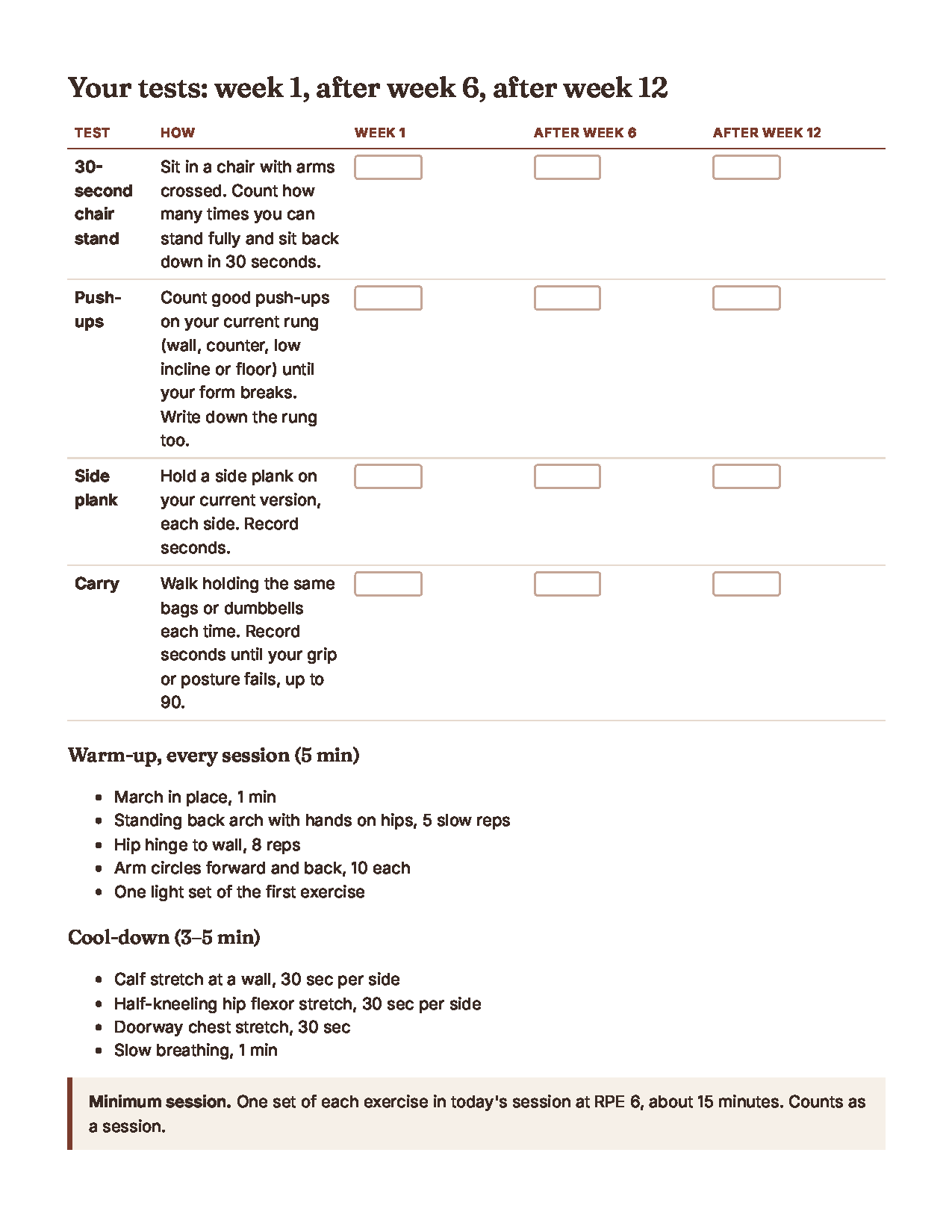
Tests at weeks 1, 6 and 12
Why strength, why now
- 2×
- the rate of fat gain at the start of the menopause transition, while lean mass starts to fall (SWAN study, 2019)
- 43.6%
- fewer moderate to severe hot flashes after 15 weeks of strength training, in one randomized trial (2019)
- 2.9%
- gain in spine bone density with supervised heavy lifting in women with low bone mass (LIFTMOR trial, 2018)
How it works
- 1
Answer six questions
Stage, experience, equipment, days a week, anything to work around, and your main goal.
- 2
A short safety check
If anything applies, your plan still arrives, with a note to show it to your doctor and gentler limits.
- 3
See week 1 free — check it before you pay
Your first week is on the next screen. Pay only if it looks right.
- 4
Pay with card, Apple Pay, Google Pay or Link
No account needed.
- 5
Download your PDF straight away
It is also saved in Your library under your email.
Who it's for
Women in perimenopause or after menopause who are new to lifting, returning after a break, or training without a plan. It is general exercise guidance, not medical advice.
Want meals to match?
The 28-day meal plan is built to hit your protein target, with weekly shopping lists. Get both for $39.
Questions
Do I need a gym?▾
No. Choose home with no equipment, home with bands and dumbbells, or a gym, and every exercise is picked for what you have.
I've never lifted weights.▾
Then you start on the first rung of each exercise. The plan tells you when to move up.
How long are the sessions?▾
About 30 minutes in weeks 1 to 4, 40 in weeks 5 to 8 and 45 in weeks 9 to 12. On a bad day, a 15-minute minimum session counts.
I have osteoporosis.▾
Your plan follows the UK consensus on exercise for osteoporosis: no sit-ups or crunches, back-extension and balance work from week 1, and impact limited to heel drops and stomps until your doctor or physical therapist agrees.
Will it help my hot flashes?▾
It might. In one trial, 15 weeks of strength training cut moderate to severe hot flashes by 43.6%. One trial is not proof, so we don't promise it.
Is this an app?▾
It is a PDF you can print or keep on your phone. If you'd rather have tracking done for you, that's the Perimenostage app.
What if it's not for me?▾
Refund within 30 days with one button in Your library. The charge shows as LINK.COM* PERIMENOSTAGE.
Your 12 weeks, built from your answers.
Six questions, then see week 1 free.
30-day money-back guarantee.
Sources
▾
- Greendale GA, et al. Changes in body composition and weight during the menopause transition. JCI Insight. 2019;4(5):e124865. PubMed 30843880
- Berin E, et al. Resistance training for hot flushes in postmenopausal women: a randomised controlled trial. Maturitas. 2019;126:55-60. PubMed 31239119
- Watson SL, et al. High-intensity resistance and impact training improves bone mineral density and physical function in postmenopausal women with osteopenia and osteoporosis: the LIFTMOR randomized controlled trial. J Bone Miner Res. 2018;33(2):211-220. PubMed 28975661
- Brooke-Wavell K, et al. Strong, steady and straight: UK consensus statement on physical activity and exercise for osteoporosis. Br J Sports Med. 2022;56(15):837-846. PubMed 35577538