
Perimenostage data · Updated November 22, 2026 · Next update: November 2027
Perimenopause symptoms ranked: what the US searches vs what's most common
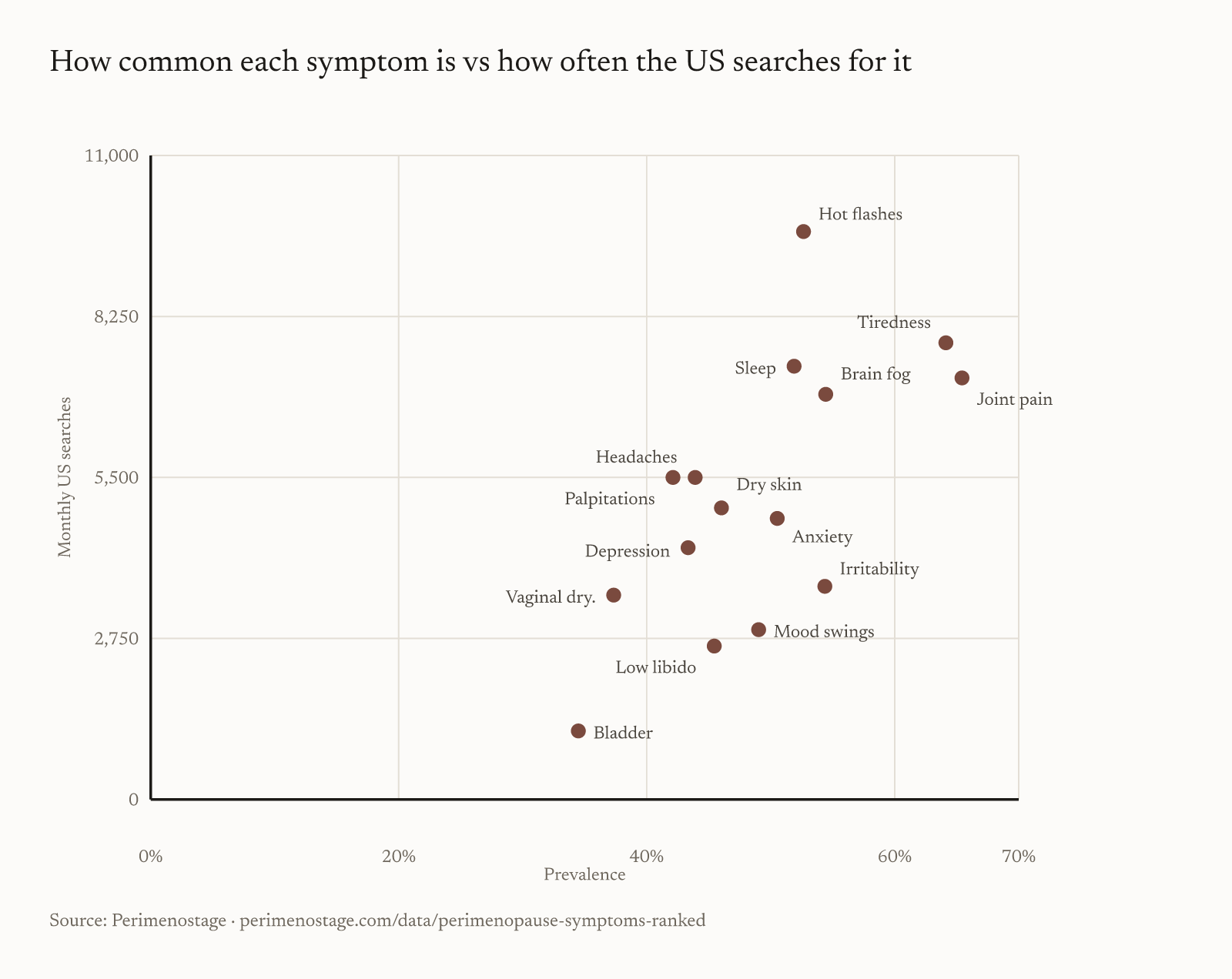
Joint and muscle pain is the most common menopause symptom: 65.43% of midlife women have it, in a meta-analysis of 321 studies. Exhaustion (64.13%) and poor memory (54.44%) come next, and hot flashes (52.65%) only fifth. Yet hot flashes and night sweats get the most US searches, 9,700 a month. Bladder problems, at 34.49%, get the fewest: 1,170.
Perimenopause symptoms by the numbers
65.43%
of middle-aged women have joint and muscle pain, the most common of 19 symptoms in a meta-analysis of 482,067 women.
9,700
US searches a month for hot flashes and night sweats with menopause or perimenopause, the most of any symptom with a prevalence figure.
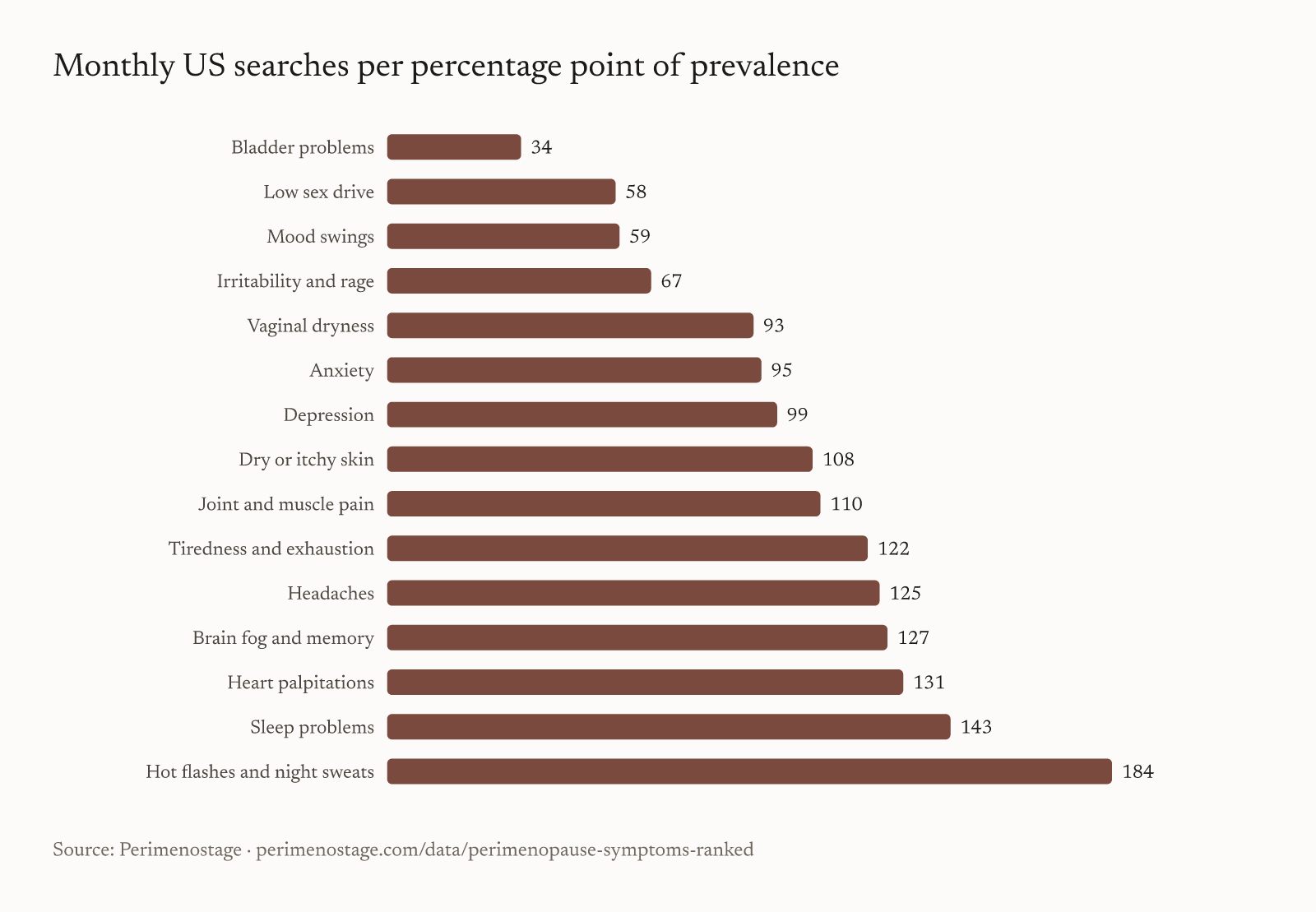
184 vs 34
searches per percentage point of prevalence: hot flashes against bladder problems.
18,400
searches a month for irregular periods with menopause or perimenopause, more than any symptom we checked. The meta-analysis didn't measure it.
How common each symptom is vs how often the US searches for it
Source: Perimenostage analysis of Google Ads search volume and Googl
Monthly US searches per percentage point of prevalence
Source: Perimenostage analysis of Google Ads search volume and Googl
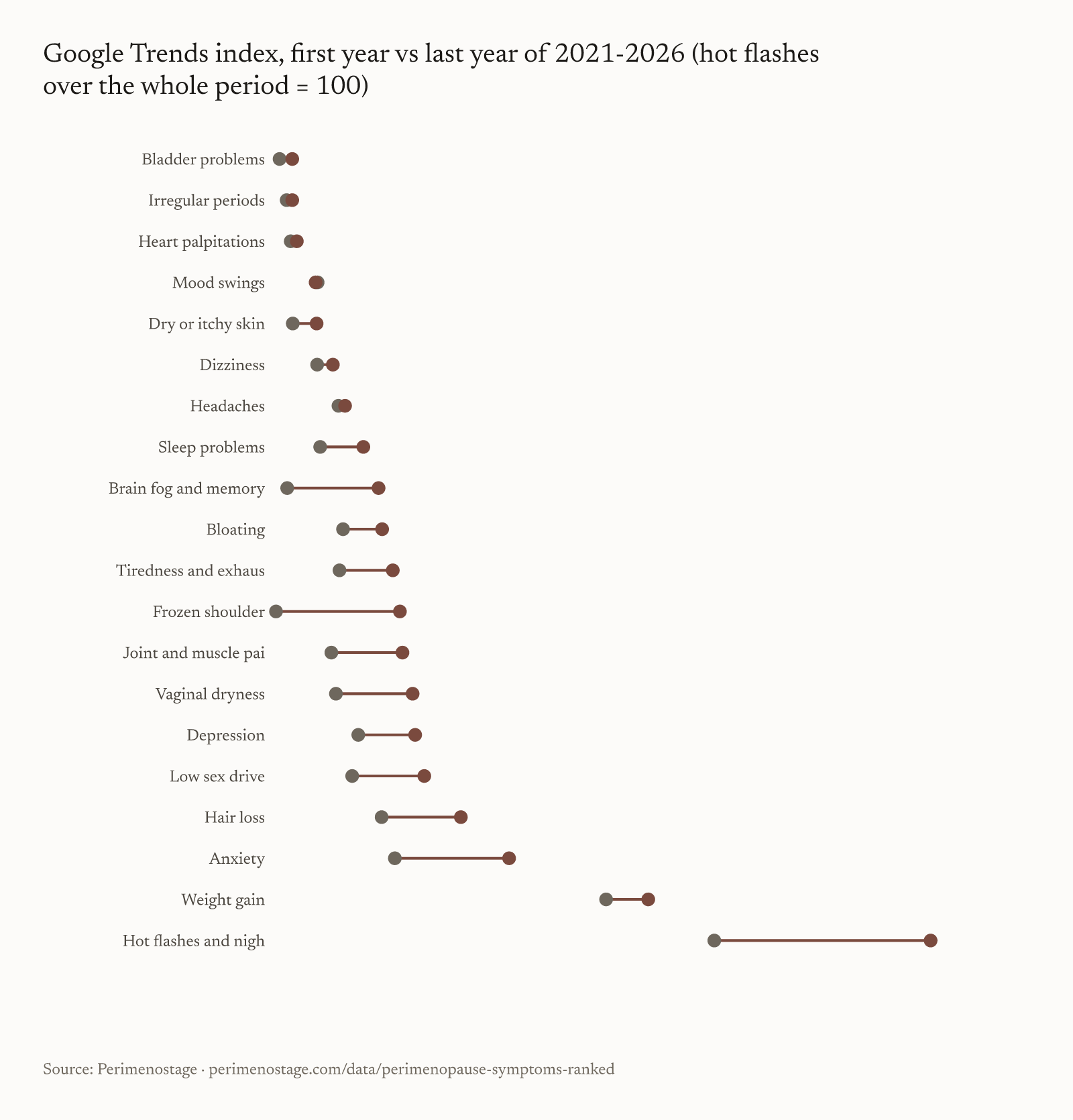
Google Trends index, first year vs last year of 2021-2026 (hot flashes over the whole period = 100)
Source: Perimenostage analysis of Google Ads search volume and Googl
Perimenopause symptoms: searches, prevalence and trend
Irregular periods
- US searches a month
- 18,400
- Women with it
- —
- Searches per point
- —
- Trends, first year
- 2.1
- Trends, last year
- 3.2
Weight gain
- US searches a month
- 10,800
- Women with it
- —
- Searches per point
- —
- Trends, first year
- 65
- Trends, last year
- 73.3
Hair loss
- US searches a month
- 9,800
- Women with it
- —
- Searches per point
- —
- Trends, first year
- 20.8
- Trends, last year
- 36.4
Hot flashes and night sweats
- US searches a month
- 9,700
- Women with it
- 52.65%
- Searches per point
- 184
- Trends, first year
- 86.3
- Trends, last year
- 128.9
Tiredness and exhaustion
- US searches a month
- 7,800
- Women with it
- 64.13%
- Searches per point
- 122
- Trends, first year
- 12.5
- Trends, last year
- 23
Sleep problems
- US searches a month
- 7,400
- Women with it
- 51.89%
- Searches per point
- 143
- Trends, first year
- 8.7
- Trends, last year
- 17.2
Joint and muscle pain
- US searches a month
- 7,200
- Women with it
- 65.43%
- Searches per point
- 110
- Trends, first year
- 10.9
- Trends, last year
- 24.9
Brain fog and memory
- US searches a month
- 6,920
- Women with it
- 54.44%
- Searches per point
- 127
- Trends, first year
- 2.2
- Trends, last year
- 20.2
Headaches
- US searches a month
- 5,500
- Women with it
- 43.91%
- Searches per point
- 125
- Trends, first year
- 12.3
- Trends, last year
- 13.6
Heart palpitations
- US searches a month
- 5,500
- Women with it
- 42.12%
- Searches per point
- 131
- Trends, first year
- 2.9
- Trends, last year
- 4.1
Dry or itchy skin
- US searches a month
- 4,980
- Women with it
- 46.03%
- Searches per point
- 108
- Trends, first year
- 3.3
- Trends, last year
- 8
Anxiety
- US searches a month
- 4,800
- Women with it
- 50.53%
- Searches per point
- 95
- Trends, first year
- 23.4
- Trends, last year
- 45.9
Depression
- US searches a month
- 4,300
- Women with it
- 43.34%
- Searches per point
- 99
- Trends, first year
- 16.2
- Trends, last year
- 27.4
Bloating
- US searches a month
- 4,000
- Women with it
- —
- Searches per point
- —
- Trends, first year
- 13.2
- Trends, last year
- 20.9
Dizziness
- US searches a month
- 3,700
- Women with it
- —
- Searches per point
- —
- Trends, first year
- 8.1
- Trends, last year
- 11.2
Irritability and rage
- US searches a month
- 3,640
- Women with it
- 54.37%
- Searches per point
- 67
- Trends, first year
- —
- Trends, last year
- —
Vaginal dryness
- US searches a month
- 3,490
- Women with it
- 37.34%
- Searches per point
- 93
- Trends, first year
- 11.8
- Trends, last year
- 26.9
Mood swings
- US searches a month
- 2,900
- Women with it
- 49.03%
- Searches per point
- 59
- Trends, first year
- 8.2
- Trends, last year
- 7.8
Low sex drive
- US searches a month
- 2,620
- Women with it
- 45.45%
- Searches per point
- 58
- Trends, first year
- 15
- Trends, last year
- 29.2
Frozen shoulder
- US searches a month
- 1,300
- Women with it
- —
- Searches per point
- —
- Trends, first year
- 0
- Trends, last year
- 24.4
Bladder problems
- US searches a month
- 1,170
- Women with it
- 34.49%
- Searches per point
- 34
- Trends, first year
- 0.7
- Trends, last year
- 3.2
What the perimenopause symptom data shows
The most common perimenopause symptom isn't hot flashes
A 2024 meta-analysis pooled 321 studies of 482,067 middle-aged women and estimated how common 19 symptoms are. Joint and muscle discomfort came first at 65.43%, then physical and mental exhaustion at 64.13%, poor memory at 54.44% and irritability at 54.37%. Hot flashes were fifth, at 52.65%. We expected hot flashes on top, because that's the symptom everyone names first. Sleep problems, anxiety and mood swings all sat around half.
Which perimenopause symptoms the US searches most
Adding up searches for each symptom with "menopause" and "perimenopause", hot flashes and night sweats lead with 9,700 a month. Tiredness has 7,800, sleep problems 7,400, joint and muscle pain 7,200, and brain fog and memory 6,920. Bladder problems trail with 1,170, and that one surprised us most. On Google Trends, "menopause hot flashes" beats every other symptom phrase too; "menopause weight gain" comes closest, at 69 against 100.
The under-searched symptoms: bladder, sex drive and mood
Divide searches by how many women have each symptom and the gap shows. Hot flashes and night sweats get 184 searches a month per percentage point, sleep problems 143. Bladder problems get 34, low sex drive 58, mood swings 59 and irritability and rage 67. Our guess is that women don't connect these with menopause, or don't want to type them. The data can't tell which.
Learn more →Fastest-rising perimenopause symptom searches
On Google Trends, with hot flashes over five years set at 100, "menopause brain fog" averaged 2.2 in the first year and 20.2 in the last. "Menopause frozen shoulder" went from 0 to 24.4. Joint pain rose from 10.9 to 24.9, vaginal dryness from 11.8 to 26.9 and anxiety from 23.4 to 45.9. Mood swings didn't move: 8.2, then 7.8. We don't know why that one stalled. Hot flashes grew too, from 86.3 to 128.9.
Learn more →Searched a lot, missing from the symptom scales
Three of the biggest searches aren't among the 19 symptoms the meta-analysis pooled: irregular periods at 18,400 a month, weight gain at 10,800 and hair loss at 9,800. Bloating has 4,000 and dizziness 3,700. Women are searching for things the standard questionnaires don't ask about. Irregular periods searches also swing hard from month to month, so treat that one as a range rather than a fixed number. Weight gain and hair loss are steady.
Learn more →Why the perimenopause symptom figures are worldwide
The meta-analysis is global, and prevalence differs by place. Hot flashes affected 49.72% of women in high-income countries against 65.93% in low-income ones. Vaginal dryness was twice as common after menopause as before it: 44.81% against 21.16%. We didn't find a US study that measures all 19 symptoms the same way, so we used the pooled figures and kept the search data strictly US.
Learn more →How we ranked the perimenopause symptoms
Searches: Google Ads average monthly searches in the US, November 2025 to October 2026, through DataForSEO, adding up each symptom's "menopause" and "perimenopause" phrases. Trend: Google Trends, US, weekly, November 2021 to November 2026, five phrases per request with "menopause weight gain" in every request so they share one scale. Prevalence: pooled worldwide figures from a 2024 meta-analysis of 321 studies. We matched each search to the closest of its 19 symptoms.
Download and embed
Embed this chart
Cite this
Credit line
Full citation (APA)
Need the search data for one symptom, by month or with more phrases? Email press@perimenostage.com and we'll send a custom cut.
Free to reuse under CC BY 4.0 with a link to this page
Perimenopause symptoms ranked: questions
What is the most common perimenopause symptom?
Joint and muscle pain. A 2024 meta-analysis of 321 studies found it in 65.43% of middle-aged women, just ahead of physical and mental exhaustion at 64.13%. Hot flashes came fifth at 52.65%, after poor memory and irritability.
Which perimenopause symptom do people search for most?
Of the symptoms with a prevalence figure, hot flashes and night sweats: 9,700 US searches a month with "menopause" or "perimenopause". Counting everything we checked, irregular periods lead with 18,400, then weight gain with 10,800 and hair loss with 9,800.
Are hot flashes the main symptom of perimenopause?
They're what you'll hear about first and what gets searched most and the best known, but not the most common. In the meta-analysis, 52.65% of women had hot flashes, against 65.43% with joint and muscle pain and 64.13% with exhaustion. In high-income countries the figure for hot flashes was lower, 49.72%.
Which perimenopause symptoms are least talked about?
On our measure, bladder problems: 1,170 US searches a month for a symptom that 34.49% of women have, or 34 searches per percentage point. Low sex drive (58) and mood swings (59) are next. Hot flashes get 184.
Is frozen shoulder a perimenopause symptom?
It's a fast-growing search: on Google Trends, "menopause frozen shoulder" went from 0 in the first year of 2021-2026 to 24.4 in the last, near joint pain. The meta-analysis didn't measure frozen shoulder separately; joint and muscle discomfort, at 65.43%, is the closest symptom.
Which perimenopause symptom searches are rising fastest?
Brain fog, from a Trends index of 2.2 to 20.2 between the first and last year of 2021-2026, and frozen shoulder, from 0 to 24.4. Dry or itchy skin, joint pain and vaginal dryness more than doubled. Mood swings stayed flat.
How can I tell which of my symptoms are from perimenopause?
Score them, it's quicker than guessing. The Menopause Rating Scale covers 11 of these symptoms and gives you a total and three subscales in about a minute. Irregular periods, which it doesn't score, tell you your stage: that's what the full check asks about.
Can I use this perimenopause symptom data?
Yes. The CSV is free under CC BY 4.0: credit Perimenostage and link to this page. For a custom cut, such as one symptom by month or more search phrases, email press@perimenostage.com.
Sources
- Fang Y, Liu F, Zhang X, et al. Mapping global prevalence of menopausal symptoms among middle-aged women: a systematic review and meta-analysis. BMC Public Health. 2024;24:1767.
- Perimenostage analysis of Google Ads search volume and Google Trends data via DataForSEO, United States, November 2021 to November 2026. Accessed November 22, 2026.
- Google. FAQ about Google Trends data. Trends Help.
- Heinemann K, Ruebig A, Potthoff P, et al. The Menopause Rating Scale (MRS) scale: a methodological review. Health Qual Life Outcomes. 2004;2:45.
Related guides
Perimenopause and menopause symptoms
All the perimenopause and menopause symptoms, grouped by body system, each with its own page: causes, what hel
Menopause Rating Scale (MRS)
Score the 11-item Menopause Rating Scale in a minute: total, somatic, psychological and urogenital subscales,
Hot flash treatments ranked by how much they beat placebo
11 hot flash treatments ranked by their effect over placebo in FDA labels and meta-analyses: HRT, Lynkuet, Veo
Perimenopause searches by state
Searches for perimenopause rose 4.4-fold since 2021. Every state's interest, how often women say perimenopause
Joint pain in menopause
Aching, stiff joints are a common and overlooked menopause symptom. How estrogen affects joints, how to tell i
Brain fog and memory loss in menopause
Forgetting words and losing focus is common in perimenopause and usually improves after menopause. Why it happ