
Perimenostage data · Updated October 22, 2026 · Next update: November 2026
Veozah and Lynkuet side effects: what people report to the FDA
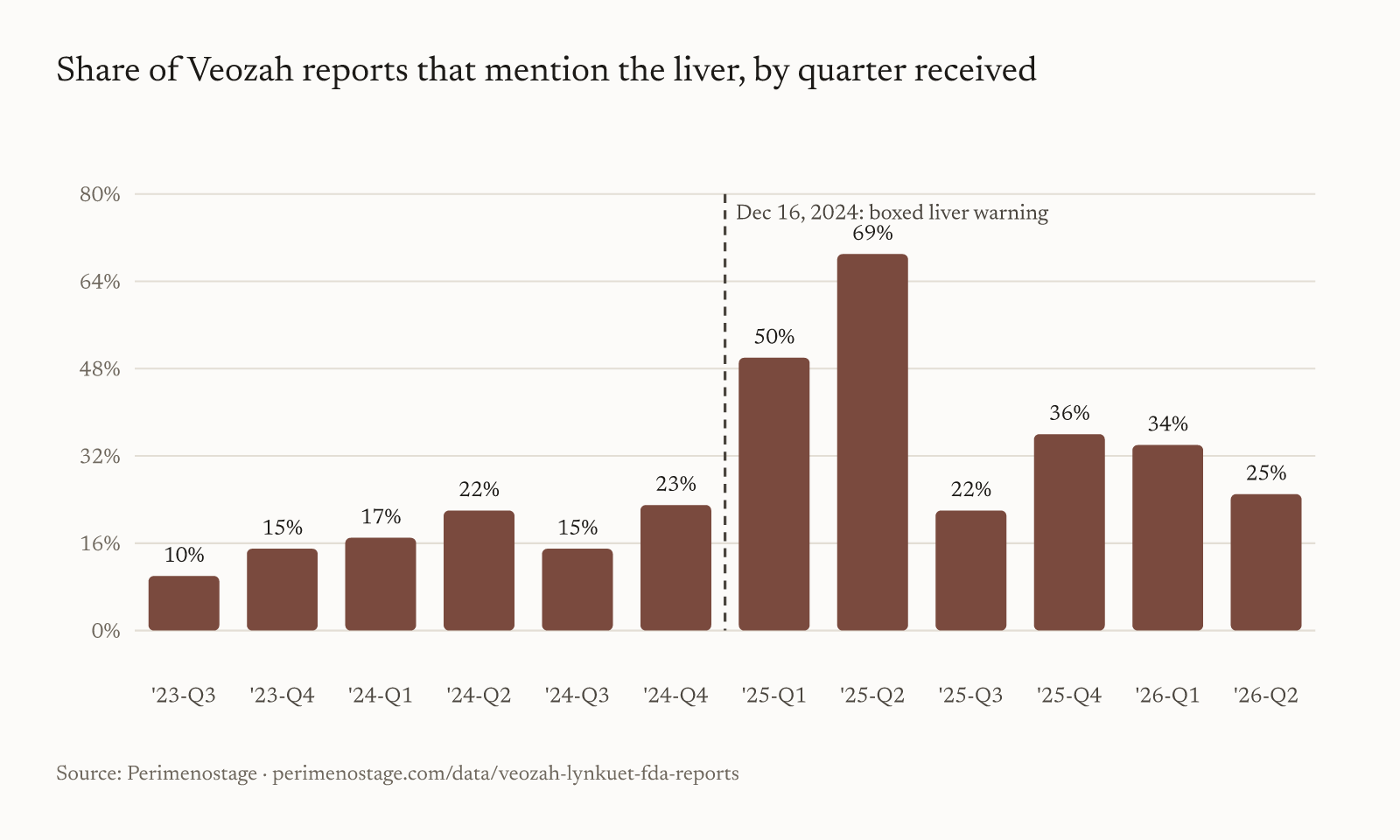
Since Veozah (fezolinetant) was approved in 2023, the FDA has received 2,122 adverse event reports about it, and 607 of them (28.6%) mention the liver. After the FDA added a boxed liver warning in December 2024, the liver share of reports jumped to 50% and then 69% a quarter. Lynkuet (elinzanetant), approved in 2025, has 251 reports so far, and the most common is sleepiness.
Veozah and Lynkuet FDA reports by the numbers
2,122
reports about Veozah in the FDA's adverse event system, 428 of them serious.
28.6%
of Veozah reports mention the liver: 607 reports.
69%
of Veozah reports received in April to June 2025 mentioned the liver, after the boxed warning. Before it: 10% to 23%.
19.1%
of the 251 Lynkuet reports are about sleepiness, the most common report.
Share of Veozah reports that mention the liver, by quarter received
Source: US Food and Drug Administration
Lynkuet reports to the FDA, by quarter received
Source: US Food and Drug Administration
Most reported Veozah and Lynkuet reactions
Veozah (fezolinetant): 2,122 reports to the FDA, 428 serious · data through July 30, 2026
| Reaction | Reports | Share |
|---|---|---|
| Didn't work | 250 | 11.8% |
| ALT (liver enzyme) increased | 192 | 9.0% |
| Liver enzymes increased | 191 | 9.0% |
| AST (liver enzyme) increased | 147 | 6.9% |
| Used off label | 122 | 5.7% |
| Headache | 121 | 5.7% |
| Nausea | 102 | 4.8% |
| Hot flash | 100 | 4.7% |
| Liver function test increased | 92 | 4.3% |
| Insomnia | 88 | 4.1% |
Lynkuet (elinzanetant): 251 reports to the FDA, 58 serious · data through July 30, 2026
| Reaction | Reports | Share |
|---|---|---|
| Sleepiness | 48 | 19.1% |
| Fatigue | 32 | 12.7% |
| Dizziness | 28 | 11.2% |
| Wrong dose taken | 22 | 8.8% |
| Headache | 21 | 8.4% |
| Nausea | 19 | 7.6% |
| Didn't work | 18 | 7.2% |
| Hot flash | 15 | 6.0% |
| Vertigo | 10 | 4.0% |
| Raised liver enzymes | 9 | 3.6% |
All reactions reported 5 or more times
DRUG INEFFECTIVE
- Reports
- 250
- Share of the drug's reports
- 11.8%
ALANINE AMINOTRANSFERASE INCREASED
- Reports
- 192
- Share of the drug's reports
- 9%
HEPATIC ENZYME INCREASED
- Reports
- 191
- Share of the drug's reports
- 9%
ASPARTATE AMINOTRANSFERASE INCREASED
- Reports
- 147
- Share of the drug's reports
- 6.9%
OFF LABEL USE
- Reports
- 122
- Share of the drug's reports
- 5.7%
HEADACHE
- Reports
- 121
- Share of the drug's reports
- 5.7%
NAUSEA
- Reports
- 102
- Share of the drug's reports
- 4.8%
HOT FLUSH
- Reports
- 100
- Share of the drug's reports
- 4.7%
LIVER FUNCTION TEST INCREASED
- Reports
- 92
- Share of the drug's reports
- 4.3%
INSOMNIA
- Reports
- 88
- Share of the drug's reports
- 4.1%
DIARRHOEA
- Reports
- 81
- Share of the drug's reports
- 3.8%
FATIGUE
- Reports
- 78
- Share of the drug's reports
- 3.7%
ABDOMINAL PAIN
- Reports
- 66
- Share of the drug's reports
- 3.1%
DIZZINESS
- Reports
- 65
- Share of the drug's reports
- 3.1%
BACK PAIN
- Reports
- 51
- Share of the drug's reports
- 2.4%
ABDOMINAL PAIN UPPER
- Reports
- 45
- Share of the drug's reports
- 2.1%
CONDITION AGGRAVATED
- Reports
- 42
- Share of the drug's reports
- 2%
GAMMA-GLUTAMYLTRANSFERASE INCREASED
- Reports
- 40
- Share of the drug's reports
- 1.9%
PRURITUS
- Reports
- 38
- Share of the drug's reports
- 1.8%
NIGHT SWEATS
- Reports
- 37
- Share of the drug's reports
- 1.7%
BLOOD ALKALINE PHOSPHATASE INCREASED
- Reports
- 36
- Share of the drug's reports
- 1.7%
ARTHRALGIA
- Reports
- 34
- Share of the drug's reports
- 1.6%
FEELING ABNORMAL
- Reports
- 32
- Share of the drug's reports
- 1.5%
TRANSAMINASES INCREASED
- Reports
- 32
- Share of the drug's reports
- 1.5%
INTENTIONAL PRODUCT USE ISSUE
- Reports
- 31
- Share of the drug's reports
- 1.5%
INAPPROPRIATE SCHEDULE OF PRODUCT ADMINISTRATION
- Reports
- 30
- Share of the drug's reports
- 1.4%
DRUG INTERACTION
- Reports
- 28
- Share of the drug's reports
- 1.3%
BLOOD BILIRUBIN INCREASED
- Reports
- 26
- Share of the drug's reports
- 1.2%
WRONG TECHNIQUE IN PRODUCT USAGE PROCESS
- Reports
- 26
- Share of the drug's reports
- 1.2%
ANXIETY
- Reports
- 25
- Share of the drug's reports
- 1.2%
MALAISE
- Reports
- 25
- Share of the drug's reports
- 1.2%
PAIN
- Reports
- 25
- Share of the drug's reports
- 1.2%
RASH
- Reports
- 25
- Share of the drug's reports
- 1.2%
BLOOD PRESSURE INCREASED
- Reports
- 24
- Share of the drug's reports
- 1.1%
PALPITATIONS
- Reports
- 23
- Share of the drug's reports
- 1.1%
VOMITING
- Reports
- 23
- Share of the drug's reports
- 1.1%
DEPRESSION
- Reports
- 21
- Share of the drug's reports
- 1%
ABDOMINAL DISCOMFORT
- Reports
- 20
- Share of the drug's reports
- 0.9%
LIVER DISORDER
- Reports
- 20
- Share of the drug's reports
- 0.9%
MIGRAINE
- Reports
- 20
- Share of the drug's reports
- 0.9%
What the Veozah and Lynkuet reports show
Veozah: 2,122 reports since its approval
Veozah was approved in 2023, and by July 30, 2026 the FDA had 2,122 reports listing it. 428 (20.2%) were classed as serious. Consumers sent 993 (46.8%), physicians 738 (34.8%) and other health professionals 355 (16.7%). Many reports list several reactions, so the reaction counts below add up to more than the number of reports.
Learn more →How the Veozah liver warning changed the reports
On December 16, 2024, the FDA added a boxed warning to Veozah for rare serious liver injury and asked for liver blood tests monthly for the first 2 months, then at months 3, 6 and 9. Before that, 10% to 23% of Veozah reports each quarter mentioned the liver. In the first two quarters of 2025 the share jumped to 50% and 69%, then settled at 22% to 36%.
Why a warning makes Veozah liver reports spike
A warning that adds regular blood tests finds raised liver enzymes that would otherwise go unnoticed, and it makes doctors and patients more likely to report them. So a jump in liver reports right after a warning is expected and doesn't on its own mean the drug became more harmful. In trials, enzymes above 3 times normal occurred in 2.3% of women on Veozah and 0.9% on placebo.
The most common Veozah report: it didn't work
The single most frequent reaction term for Veozah is "drug ineffective": 250 reports, 11.8% of the total. That fits the trials, where Veozah cut moderate to severe hot flashes by 2.5 to 2.6 a day more than placebo at week 12, a real but modest benefit that some women don't notice. Another 122 reports (5.7%) note use outside the labeled indication.
Lynkuet's first 251 reports: sleepiness leads
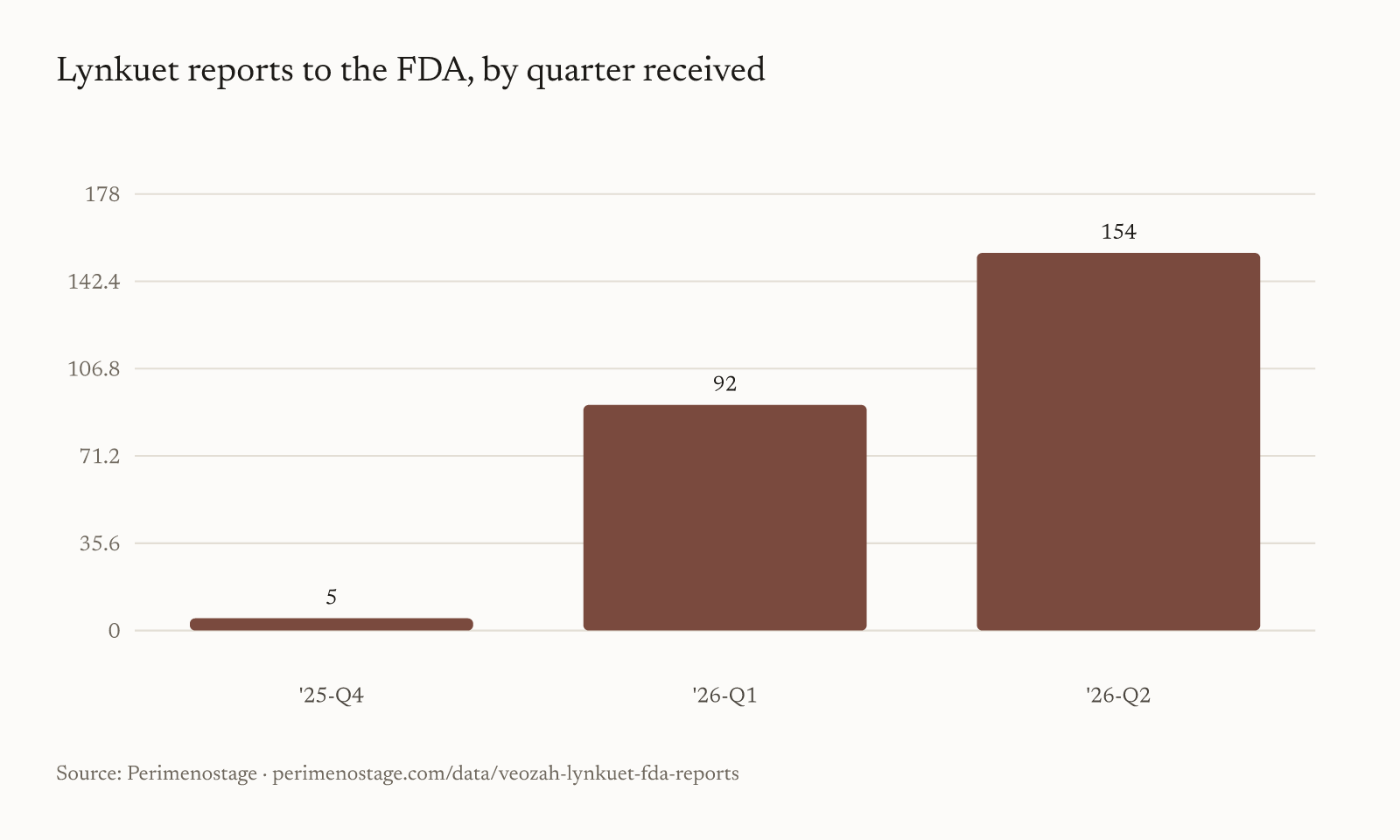
Lynkuet was approved in 2025, and reports grew from 5 in the last quarter of 2025 to 92 and then 154 in the first two quarters of 2026. The top three are sleepiness (48 reports, 19.1%), fatigue (32, 12.7%) and dizziness (28, 11.2%). These match the label's warning about nervous system effects, which affected 11.9% of women in trials, against 3.5% on placebo.
Learn more →Lynkuet dosing mistakes and seizure reports
22 Lynkuet reports (8.8%) describe a wrong dose. The usual dose is two 60 mg capsules at bedtime; one capsule is only for women who take a moderate CYP3A4 blocker. Another 5 reports describe seizures. In August 2026, the FDA label added a seizure warning based on postmarketing cases, advising caution for women with a history of seizures.
Liver reports on Lynkuet
23 Lynkuet reports (9.2%) include at least one liver term, most often raised liver enzymes. Lynkuet has no boxed warning. In its trials, enzymes rose above 3 times normal in 0.6% of women on Lynkuet and 0.4% on placebo, and the label asks for liver tests before starting and at 3 months. Report counts this early can't show how often liver problems happen.
Learn more →How we counted the reports
We queried the openFDA drug adverse event endpoint for reports that list fezolinetant or elinzanetant by generic name, with data through July 30, 2026. For each drug we counted reports per MedDRA reaction term, and we counted unique reports containing any liver term: 13 terms for Veozah and 8 for Lynkuet, such as raised ALT, AST, liver enzymes or bilirubin, liver injury and jaundice. Quarters are by the date the FDA received the report.
Download and embed
Embed this chart
Cite this
Credit line
Full citation (APA)
Need the full reaction list, a different date range or another menopause drug? Email press@perimenostage.com and we'll send a custom cut.
Free to reuse under CC BY 4.0 with a link to this page
Veozah and Lynkuet FDA reports: questions
What are the most reported side effects of Veozah?
In 2,122 FDA reports, the most common terms are "drug ineffective" (250), raised ALT (192), raised liver enzymes (191), raised AST (147), headache (121) and nausea (102). In the trials, the side effects more common than on placebo were abdominal pain, diarrhea, insomnia, back pain, hot flash and raised liver enzymes.
How many liver problems are reported with Veozah?
607 of 2,122 reports (28.6%) mention at least one liver term, most of them raised liver enzymes. Serious liver injury is rare, but it led to a boxed warning in December 2024, with liver blood tests before starting and at months 1, 2, 3, 6 and 9.
What side effects do people report with Lynkuet?
Of 251 reports, the most common are sleepiness (48), fatigue (32), dizziness (28), a wrong dose (22), headache (21) and nausea (19). Sleepiness is why Lynkuet is taken at bedtime. Five reports describe seizures, and the label now carries a seizure warning.
Is Lynkuet safer than Veozah?
FDA reports can't answer that: Lynkuet has been on the market for far less time, and report counts aren't rates. In trials, liver enzymes rose above 3 times normal in 0.6% on Lynkuet and 2.3% on Veozah, but Lynkuet more often causes sleepiness. Neither has been tested against the other.
How do I report a side effect to the FDA?
Use MedWatch at www.fda.gov/medwatch or call 1-800-FDA-1088. You can also report to the drug's maker. Include the drug, dose, start date, what happened and when, and any test results. Your report goes into the same FAERS database used on this page.
Can I use this data?
Yes. The tables and charts are free to reuse under a Creative Commons Attribution 4.0 license. Please credit Perimenostage and link to this page. You can download the reaction counts and the quarterly liver data as CSV files.
How often is this data updated?
We refresh it each time openFDA updates the FAERS database, roughly every quarter. The current figures run through July 30, 2026. Counts for Lynkuet will grow quickly as more women start it.
Sources
- US Food and Drug Administration. FDA Adverse Event Reporting System (FAERS): reports for fezolinetant (Veozah), via openFDA. Data through July 30, 2026.
- US Food and Drug Administration. FDA Adverse Event Reporting System (FAERS): reports for elinzanetant (Lynkuet), via openFDA. Data through July 30, 2026.
- US Food and Drug Administration. Drug safety communication: FDA adds warning about rare occurrence of serious liver injury with use of Veozah (fezolinetant). December 2024.
- Prescribing information: Veozah (fezolinetant tablets). Astellas Pharma, 2026. DailyMed, US National Library of Medicine.
- Prescribing information: Lynkuet (elinzanetant capsules). Bayer HealthCare, 2026. DailyMed, US National Library of Medicine.
Related guides
Lynkuet (elinzanetant) for hot flashes
Lynkuet is a non-hormonal capsule for hot flashes, taken at bedtime. How well it works, sleepiness, liver test
Veozah (fezolinetant) for hot flashes
Veozah is a non-hormonal pill for hot flashes. Side effects and the liver warning, cost and the savings card,
Lynkuet vs Veozah
Lynkuet and Veozah both block the brain signal behind hot flashes. Dose, results, liver tests, sleepiness, int
Non-hormonal treatments for hot flashes
Fezolinetant, SSRIs, SNRIs, gabapentin, oxybutynin and CBT all reduce hot flashes without hormones. How well e